Arria® 10 and Cyclone® 10 GX Avalon® Memory-Mapped (Avalon-MM) Interface for PCI Express* User Guide
ID
683724
Date
9/10/2024
Public
1. Datasheet
2. Quick Start Guide
3. Parameter Settings
4. Physical Layout
5. 64- or 128-Bit Avalon-MM Interface to the Endpoint Application Layer
6. Registers
7. Reset and Clocks
8. Interrupts for Endpoints
9. Error Handling
10. Design Implementation
11. Throughput Optimization
12. Additional Features
13. Avalon-MM Testbench and Design Example
14. Avalon-MM Testbench and Design Example for Root Port
15. Hard IP Reconfiguration
16. Debugging
A. PCI Express Protocol Stack
B. Transaction Layer Packet (TLP) Header Formats
C. Lane Initialization and Reversal
D. Arria® 10 or Cyclone® 10 GX Avalon® -MM Interface for PCIe* Solutions User Guide Archive
E. Document Revision History
1.1. Arria® 10 or Cyclone® 10 GX Avalon-MM Interface for PCIe Datasheet
1.2. Features
1.3. Release Information
1.4. Device Family Support
1.5. Configurations
1.6. Design Examples
1.7. IP Core Verification
1.8. Resource Utilization
1.9. Recommended Speed Grades
1.10. Creating a Design for PCI Express
3.1. Parameters
3.2. Avalon-MM Settings
3.3. Base Address Register (BAR) Settings
3.4. Device Identification Registers
3.5. PCI Express and PCI Capabilities Parameters
3.6. Configuration, Debug, and Extension Options
3.7. Vendor Specific Extended Capability (VSEC)
3.8. PHY Characteristics
3.9. Example Designs
5.1. 32-Bit Non-Bursting Avalon-MM Control Register Access (CRA) Slave Signals
5.2. Bursting and Non-Bursting Avalon® -MM Module Signals
5.3. 64- or 128-Bit Bursting TX Avalon-MM Slave Signals
5.4. Clock Signals
5.5. Reset, Status, and Link Training Signals
5.6. Interrupts for Endpoints when Multiple MSI/MSI-X Support Is Enabled
5.7. Hard IP Status Signals
5.8. Physical Layer Interface Signals
6.1. Correspondence between Configuration Space Registers and the PCIe Specification
6.2. Type 0 Configuration Space Registers
6.3. Type 1 Configuration Space Registers
6.4. PCI Express Capability Structures
6.5. Intel-Defined VSEC Registers
6.6. CvP Registers
6.7. 64- or 128-Bit Avalon-MM Bridge Register Descriptions
6.8. Programming Model for Avalon-MM Root Port
6.9. Uncorrectable Internal Error Mask Register
6.10. Uncorrectable Internal Error Status Register
6.11. Correctable Internal Error Mask Register
6.12. Correctable Internal Error Status Register
6.7.1.1. Avalon-MM to PCI Express Interrupt Status Registers
6.7.1.2. Avalon-MM to PCI Express Interrupt Enable Registers
6.7.1.3. PCI Express Mailbox Registers
6.7.1.4. Avalon-MM-to-PCI Express Address Translation Table
6.7.1.5. PCI Express to Avalon-MM Interrupt Status and Enable Registers for Endpoints
6.7.1.6. Avalon-MM Mailbox Registers
6.7.1.7. Control Register Access (CRA) Avalon-MM Slave Port
13.5.1. ebfm_barwr Procedure
13.5.2. ebfm_barwr_imm Procedure
13.5.3. ebfm_barrd_wait Procedure
13.5.4. ebfm_barrd_nowt Procedure
13.5.5. ebfm_cfgwr_imm_wait Procedure
13.5.6. ebfm_cfgwr_imm_nowt Procedure
13.5.7. ebfm_cfgrd_wait Procedure
13.5.8. ebfm_cfgrd_nowt Procedure
13.5.9. BFM Configuration Procedures
13.5.10. BFM Shared Memory Access Procedures
13.5.11. BFM Log and Message Procedures
13.5.12. Verilog HDL Formatting Functions
A.4.1. Avalon‑MM Bridge TLPs
A.4.2. Avalon-MM-to-PCI Express Write Requests
A.4.3. Avalon-MM-to-PCI Express Upstream Read Requests
A.4.4. PCI Express-to-Avalon-MM Read Completions
A.4.5. PCI Express-to-Avalon-MM Downstream Write Requests
A.4.6. PCI Express-to-Avalon-MM Downstream Read Requests
A.4.7. Avalon-MM-to-PCI Express Read Completions
A.4.8. PCI Express-to-Avalon-MM Address Translation for 32-Bit Bridge
A.4.9. Minimizing BAR Sizes and the PCIe Address Space
A.4.10. Avalon® -MM-to-PCI Express Address Translation Algorithm for 32-Bit Addressing
2.5. Compiling and Testing the Design in Hardware
Figure 9. Procedure
Figure 10. Software Application to Test the PCI Express Design Example on the Arria® 10 GX FPGA Development KitA software application running on a Windows PC performs the same hardware test for all of the PCI Express Design Examples.
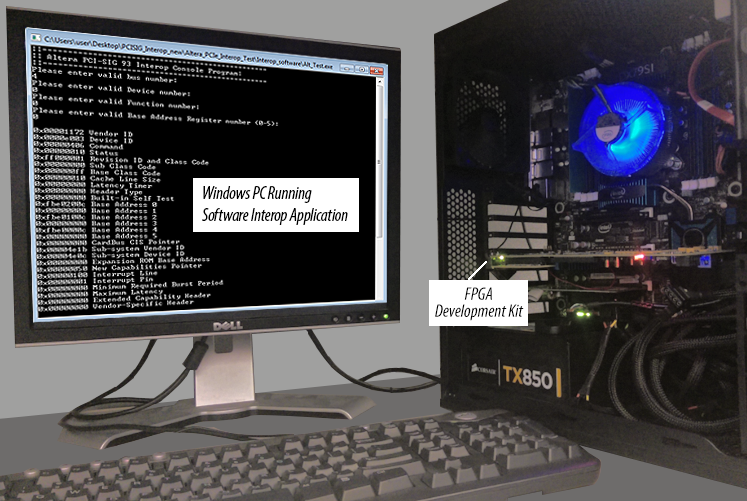
The software application to test the PCI Express Design Example on the Arria® 10 GX FPGA Development Kit is available on both 32- and 64-bit Windows 7 platforms. This program performs the following tasks:
- Prints the Configuration Space, lane rate, and lane width.
- Writes 0x00000000 to the specified BAR at offset 0x00000000 to initialize the memory and read it back.
- Writes 0xABCD1234 at offset 0x00000000 of the specified BAR. Reads it back and compares.
If successful, the test program displays the message 'PASSED'
Follow these steps to compile the design example in the Quartus Prime software:
- Launch the Quartus Prime software and open the pcie_example_design.qpf file for the example design created above.
- On the Processing > menu, select Start Compilation.
The timing constraints for the design example and the design components are automatically loaded during compilation.
Follow these steps to test the design example in hardware:
- In the <example_design>/software/windows/interop directory, unzip Altera_PCIe_Interop_Test.zip.
Note: You can also refer to readme_Altera_PCIe_interop_Test.txt file in this same directory for instructions on running the hardware test.
- Install the Intel® FPGA Windows Demo Driver for PCIe on the Windows host machine, using altera_pcie_win_driver.inf.
Note: If you modified the default Vendor ID (0x1172) or Device ID (0x0000) specified in the component parameter editor GUI, you must also modify them in altera_pcie_win_driver.inf.
- In the <example_design> directory, launch the Quartus Prime software and compile the design (Processing > Start Compilation).
- Connect the development board to the host computer.
- Configure the FPGA on the development board using the generated .sof file (Tools > Programmer).
- Open the Windows Device Manager and scan for hardware changes.
- Select the Intel® FPGA listed as an unknown PCI device and point to the appropriate 32- or 64-bit driver (altera_pice_win_driver.inf) in the Windows_driver directory.
- After the driver loads successfully, a new device named Altera PCI API Device appears in the Windows Device Manager.
- Determine the bus, device, and function number for the Altera PCI API Device listed in the Windows Device Manager.
- Expand the tab, Altera PCI API Driver under the devices.
- Right click on Altera PCI API Device and select Properties.
- Note the bus, device, and function number for the device. The following figure shows one example.
Figure 11. Determining the Bus, Device, and Function Number for New PCIe Device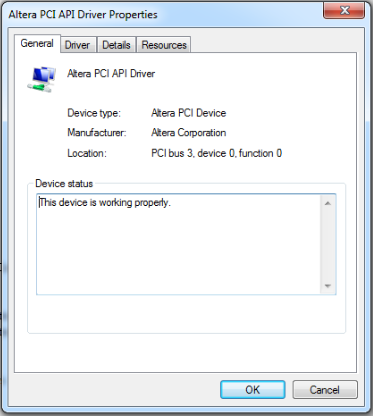
- In the <example_design>/software/windows/interop/Altera_PCIe_Interop_Test/Interop_software directory, click Alt_Test.exe.
- When prompted, type the bus, device, and function numbers and select the BAR number (0-5) you specified when parameterizing the IP core.
Note: The bus, device, and function numbers for your hardware setup may be different.
- The test displays the message, PASSED, if the test is successful.
Note: For more details on additional design implementation steps such as making pin assignments and adding timing constraints, refer to the Design Implementation chapter.