
An American flag hangs from Intel’s Fab 62 in Arizona, where construction continues on the company’s sixth high-volume manufacturing facility at Ocotillo. (Credit: Intel Corporation)
By: Naga Chandrasekaran, executive vice president and chief technology and operations officer, Intel Foundry
Semiconductors are so deeply integrated into our daily lives that most people do not even think about them. But they power the devices we carry, the cars we drive, the health care systems we rely on and the infrastructure that surrounds us all. Demand for computing power is growing at an unprecedented pace.
Meeting this demand requires some of the most advanced research and development (R&D), engineering and manufacturing work ever undertaken. Semiconductor manufacturing brings together breakthroughs in physics, materials science, chemistry and engineering at extraordinary precision and scale. It employs thousands of scientists, researchers, engineers, technicians and manufacturing professionals who work together to transform those breakthroughs into technologies used around the world.
While semiconductors have become increasingly central to modern life, the share manufactured in the United States declined from 37% to 10% between 1990 and 2022, according to the Semiconductor Industry Association.
For 250 years, America's ability to invent, develop and manufacture transformative technologies has helped drive global prosperity and progress. Semiconductor leadership will help determine whether America continues to do so for the next 250 years.


News Images


Harnessing the Full Spectrum of American Ingenuity
There is an important difference between technologies made in America and technologies that are truly American-made. The difference lies in the research and development process that transforms ideas into manufacturable technologies.
A leading example is the Intel 18A process node, with RibbonFET gate-all-around transistors and PowerVia backside power delivery. These features are defining a new era of transistor performance and were pioneered through decades of U.S.-based research before high-volume manufacturing began last year in 2025. In Oregon, Intel was the first in the industry to install a commercial High NA EUV lithography system and the first to integrate it into high-volume manufacturing, helping advance the technology toward broader high-volume adoption and enabling continued semiconductor scaling. That same innovation extends to advanced packaging technologies such as EMIB-T, which will enable increasingly complex systems. Together, these capabilities demonstrate what is possible when domestic R&D, technology development and manufacturing remain closely connected.
Capacity Across America
Meeting demand requires scale. In Arizona, Intel's manufacturing home for nearly half a century, Fab 62 will be our sixth high-volume manufacturing facility at the Ocotillo campus. Today, I am pleased to share that construction and tool installation at Fab 62 are now fully underway, and we expect operations to begin by the end of 2028.
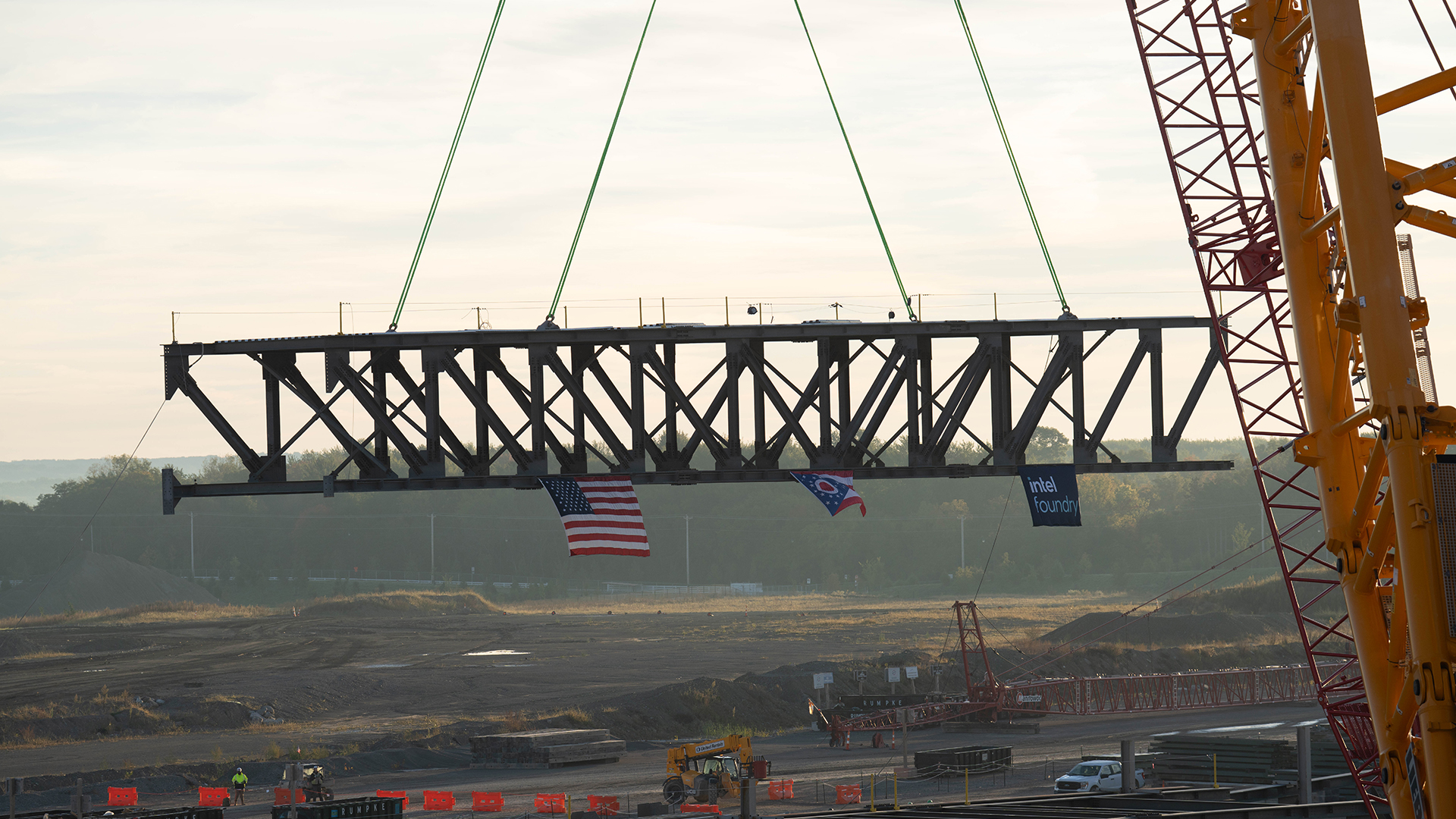
We’re also making progress in Ohio, where the first major structural truss has been installed on the first fab in New Albany. This represents another significant step toward expanded U.S. leading-edge semiconductor capacity and a visible reminder that the future of American manufacturing is being built today.
That progress builds on continued investment across our U.S. footprint. Oregon is the center of Intel's most advanced logic technology research, development and manufacturing, including the development of 3D interconnect technology. In Arizona, our teams conduct advanced packaging research and development as well as assembly and test operations alongside high-volume semiconductor manufacturing. In New Mexico, we manufacture advanced packaging technologies at scale. Earlier this year in Santa Clara, California, we also broke ground on a new mask manufacturing facility.
These investments support a U.S. supply chain that extends well beyond Arizona, Ohio, Oregon, New Mexico and California. Across our U.S. footprint, Intel works with more than 4500 suppliers in 49 states, generating more than $29 billion in annual domestic spending. This investment strengthens businesses, generates economic activity and supports communities across the country. It also helps communities build the workforce, infrastructure and local capacity needed to participate in America’s semiconductor future.
Above all, these are investments in people. Alongside our suppliers, educational institutions and community partners, we are helping train and develop the skilled workforce that will power the next generation of U.S. semiconductor manufacturing. If you are inspired to help solve some of the world's most complex engineering and manufacturing challenges, I encourage you to explore opportunities at Intel Careers.
All told, Intel and our suppliers support a nationwide semiconductor corridor that connects hundreds of thousands of people across research, development and manufacturing facilities in five states, while reaching suppliers across the country. Through continued collaboration with and investment in our ecosystem partners, we are bringing advanced semiconductor technologies from lab to fab to global scale.
This is what’s possible when we invent, develop and manufacture leading-edge semiconductors in America. The result is innovation that improves lives around the world.
America is ready to build it.

Intel’s Ohio One site reaches a construction milestone as crews install the first major structural truss for the first fab in New Albany. (Credit: Intel Corporation)