Developer Reference for Intel® oneAPI Math Kernel Library for Fortran
vslSkipAheadStream
Initializes a stream using the block-splitting method.
Syntax
status = vslskipaheadstream ( stream , nskip )
Include Files
mkl.fi , mkl_vsl.f90
Input Parameters
Name |
Type |
Description |
|---|---|---|
stream |
TYPE(VSL_STREAM_STATE), INTENT(IN) |
Descriptor of the stream to which block-splitting method is applied |
nskip |
INTEGER(KIND=8) , INTENT(IN) |
Number of skipped elements |
Description
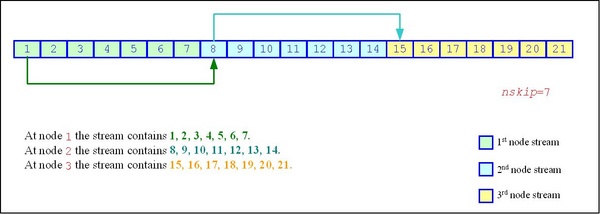
vslSkipAheadStream The vslSkipAheadStream function skips a given number of elements in a random stream . This feature is particularly useful in distributing random numbers from original random stream across different computational nodes. If the largest number of random numbers used by a computational node is nskip , then the original random sequence may be split by vslSkipAheadStream into non-overlapping blocks of nskip size so that each block corresponds to the respective computational node. The number of computational nodes is unlimited. This method is known as the block-splitting method or as the skip-ahead method. (see Figure “Block-Splitting Method” ).
Block-Splitting Method
The skip-ahead method is supported only for those basic generators that allow skipping elements by the skip-ahead method, which is more efficient than simply generating them by generator with subsequent manual skipping. See [VSNotes] for details.
Please note that for quasi-random basic generators the skip-ahead method works with components of quasi-random vectors rather than with whole quasi-random vectors. Therefore, to skip NS quasi-random vectors, set the nskip parameter equal to the NS*DIMEN , where DIMEN is the dimension of the quasi-random vector. If this operation results in exceeding the period of the quasi-random number generator, the library returns the VSL_RNG_ERROR_QRNG_PERIOD_ELAPSED error code.
The following code illustrates how to initialize three independent streams using the vslSkipAheadStream function:
Code for Block-Splitting Method
...
type(VSL_STREAM_STATE)  ::stream1
type(VSL_STREAM_STATE)  ::stream2
type(VSL_STREAM_STATE)  ::stream3

! Creating the 1st stream
status = vslnewstream(stream1, VSL_BRNG_MCG31, 174)

! Skipping ahead by 7 elements the 2nd stream
status = vslcopystream(stream2, stream1);
status = vslskipaheadstream(stream2, 7);

! Skipping ahead by 7 elements the 3rd stream
status = vslcopystream(stream3, stream2);
status = vslskipaheadstream(stream3, 7);

! Generating random numbers
...
! Deleting the streams
status = vsldeletestream(stream1)
status = vsldeletestream(stream2)
status = vsldeletestream(stream3)
...
Return Values
- VSLi_ERROR_OK , VSL_STATUS_OK
-
Indicates no error, execution is successful.
- VSL_ERROR_NULL_PTR
-
stream is a NULL pointer.
- VSL_RNG_ERROR_BAD_STREAM
-
stream is not a valid random stream.
- VSL_RNG_ERROR_SKIPAHEAD_UNSUPPORTED
-
BRNG does not support the Skip-Ahead method.
- VSL_RNG_ERROR_QRNG_PERIOD_ELAPSED
-
Period of the quasi-random number generator is exceeded.