Developer Reference for Intel® oneAPI Math Kernel Library for Fortran
p?latrz
Reduces an upper trapezoidal matrix to upper triangular form by means of orthogonal/unitary transformations.
Syntax
call pslatrz ( m , n , l , a , ia , ja , desca , tau , work )
call pdlatrz ( m , n , l , a , ia , ja , desca , tau , work )
call pclatrz ( m , n , l , a , ia , ja , desca , tau , work )
call pzlatrz ( m , n , l , a , ia , ja , desca , tau , work )
Include Files
mkl_scalapack.h
Description
pslatrz pdlatrz pclatrz pzlatrz The p?latrz routine function reduces the m -by- n(m ≤ n) real/complex upper trapezoidal matrix sub(A) = [A(ia:ia+m-1, ja:ja+m-1)A(ia:ia+m-1, ja+n-l:ja+n-1)] to upper triangular form by means of orthogonal/unitary transformations.
The upper trapezoidal matrix sub( A ) is factored as
sub(A) = ( R 0 )*Z ,
where Z is an n -by- n orthogonal/unitary matrix and R is an m -by -m upper triangular matrix.
Input Parameters
m
(global) INTEGER .
The number of rows in the distributed matrix sub( A ). m ≥ 0 .
n
(global) INTEGER .
The number of columns in the distributed matrix sub( A ). n ≥ 0 .
l
(global) INTEGER .
The number of columns of the distributed matrix sub( A ) containing the meaningful part of the Householder reflectors. l > 0 .
- a
-
(local) REAL for pslatrz DOUBLE PRECISION for pdlatrz COMPLEX for pclatrz COMPLEX*16 for pzlatrz .
Pointer into the local memory to an array of size (lld_a, LOCc(ja+n-1)) . On entry, the local pieces of the m -by- n distributed matrix sub( A ), which is to be factored.
ia
(global) INTEGER .
The row index in the global matrix A indicating the first row of sub( A ).
ja
(global) INTEGER .
The column index in the global matrix A indicating the first column of sub( A ).
desca
(global and local) INTEGER array of size dlen_ .
The array descriptor for the distributed matrix A .
- work
-
(local) REAL for pslatrz DOUBLE PRECISION for pdlatrz COMPLEX for pclatrz COMPLEX*16 for pzlatrz . Workspace array of size lwork . lwork ≥ nq0 + max(1, mp0) , where iroff = mod(ia-1, mb_a),icoff = mod(ja-1, nb_a) , iarow = indxg2p(ia, mb_a, myrow, rsrc_a, nprow) , iacol = indxg2p(ja, nb_a, mycol, csrc_a, npcol) , mp0 = numroc(m+iroff, mb_a, myrow, iarow, nprow) , nq0 = numroc(n+icoff, nb_a, mycol, iacol, npcol) ,
numroc , indxg2p , and numroc are ScaLAPACK tool functions; myrow , mycol , nprow , and npcol can be determined by calling the subroutine blacs_gridinfo .
Output Parameters
- a
-
On exit, the leading m -by- m upper triangular part of sub( A ) contains the upper triangular matrix R , and elements n-l+1 to n of the first m rows of sub( A ), with the array tau , represent the orthogonal/unitary matrix Z as a product of m elementary reflectors.
- tau
-
(local) REAL for pslatrz DOUBLE PRECISION for pdlatrz COMPLEX for pclatrz COMPLEX*16 for pzlatrz . Array of size LOCr(ja+m-1) . This array contains the scalar factors of the elementary reflectors. tau is tied to the distributed matrix A .
Application Notes
The factorization is obtained by Householder’s method. The k -th transformation matrix, Z(k) , which is used (or, in case of complex routines functions , whose conjugate transpose is used) to introduce zeros into the (m - k + 1) -th row of sub( A ), is given in the form
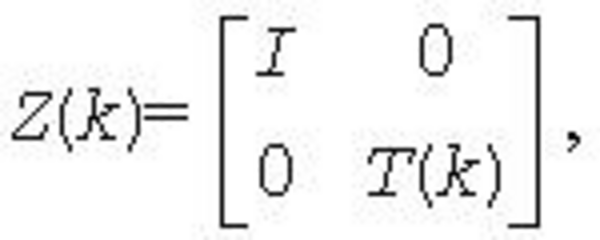
where
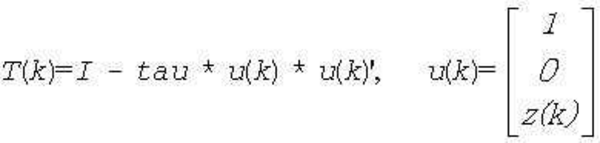
tau is a scalar and z( k ) is an ( n-m )-element vector. tau and z( k ) are chosen to annihilate the elements of the k -th row of sub( A ). The scalar tau is returned in the k -th element of tau and the vector u( k ) in the k -th row of sub( A ), such that the elements of z(k ) are in A( k, m + 1 ), ...,A( k, n ) . The elements of R are returned in the upper triangular part of sub( A ).
Z = Z(1)Z(2)...Z(m).