Developer Reference for Intel® oneAPI Math Kernel Library for Fortran
?larfb
Applies a block reflector or its transpose/conjugate-transpose to a general rectangular matrix.
Syntax
call slarfb ( side , trans , direct , storev , m , n , k , v , ldv , t , ldt , c , ldc , work , ldwork )
call dlarfb ( side , trans , direct , storev , m , n , k , v , ldv , t , ldt , c , ldc , work , ldwork )
call clarfb ( side , trans , direct , storev , m , n , k , v , ldv , t , ldt , c , ldc , work , ldwork )
call zlarfb ( side , trans , direct , storev , m , n , k , v , ldv , t , ldt , c , ldc , work , ldwork )
Include Files
mkl.fi
Description
The real flavors of the routine ?larfb apply a real block reflector H or its transpose H:code:`T` to a real m -by- n matrix C from either left or right.
The complex flavors of the routine ?larfb apply a complex block reflector H or its conjugate transpose H:code:`H` to a complex m -by- n matrix C from either left or right.
Input Parameters
The data types are given for the Fortran interface.
side
CHARACTER*1 .
If side = 'L' : apply H or H:code:`T` for real flavors and H or H:code:`H` for complex flavors from the left. If side = 'R' : apply H or H:code:`T` for real flavors and H or H:code:`H` for complex flavors from the right.
trans
CHARACTER*1 .
If trans = 'N' : apply H (No transpose). If trans = 'C' : apply H:code:`H` (Conjugate transpose). If trans = 'T' : apply H:code:`T` (Transpose).
direct
CHARACTER*1 .
Indicates how H is formed from a product of elementary reflectors If direct = 'F' : H = H(1)*H(2)*. . . *H(k) (forward) If direct = 'B' : H = H(k)* . . . H(2)*H(1) (backward)
storev
CHARACTER*1 .
Indicates how the vectors which define the elementary reflectors are stored: If storev = 'C' : Column-wise If storev = 'R' : Row-wise
m
INTEGER . The number of rows of the matrix C .
n
INTEGER . The number of columns of the matrix C .
k
INTEGER . The order of the matrix T (equal to the number of elementary reflectors whose product defines the block reflector).
- v
-
REAL for slarfb DOUBLE PRECISION for dlarfb COMPLEX for clarfb DOUBLE COMPLEX for zlarfb Array, DIMENSION ( ldv , k ) if storev = 'C' ( ldv , m ) if storev = 'R' and side = 'L' ( ldv , n ) if storev = 'R' and side = 'R' The matrix v . See Application Notes below.
- ldv
-
INTEGER . The leading dimension of the array v . If storev = 'C' and side = 'L' , ldv≥ max(1,m) ; if storev = 'C' and side = 'R' , ldv≥ max(1,n) ; if storev = 'R' , ldv≥k .
- v
-
The size limitations depend on values of parameters storev and side as described in the following table: The matrix v . See Application Notes below.
ldv
INTEGER . The leading dimension of the array v .It should satisfy the following conditions:
- t
-
REAL for slarfb DOUBLE PRECISION for dlarfb COMPLEX for clarfb DOUBLE COMPLEX for zlarfb
Array, size ( ldt , k ) .
Contains the triangular k -by- k matrix T in the representation of the block reflector.
ldt
INTEGER . The leading dimension of the array t .
ldt≥k .
- c
-
REAL for slarfb DOUBLE PRECISION for dlarfb COMPLEX for clarfb DOUBLE COMPLEX for zlarfb
Array, size ( ldc , n ) .
On entry, the m -by- n matrix C .
ldc
INTEGER . The leading dimension of the array c .
ldc≥ max(1,m) .
- work
-
REAL for slarfb DOUBLE PRECISION for dlarfb COMPLEX for clarfb DOUBLE COMPLEX for zlarfb Workspace array, DIMENSION ( ldwork , k ).
- ldwork
-
INTEGER . The leading dimension of the array work . If side = 'L' , ldwork≥ max(1, n) ; if side = 'R' , ldwork≥ max(1, m) .
Output Parameters
- c
-
On exit, c is overwritten by the product of the following: H * C, or H:code:`T` * C, or C * H, or C * H:code:`T` for real flavors H * C, or H:code:`H` * C, or C * H, or C * H:code:`H` for complex flavors
info
INTEGER .
If info = 0 , the execution is successful.
If info = -i , the i -th parameter had an illegal value.
If info = -1011 , memory allocation error occurred.
Return Values
No return value, info is an Output Parameter.
Application Notes
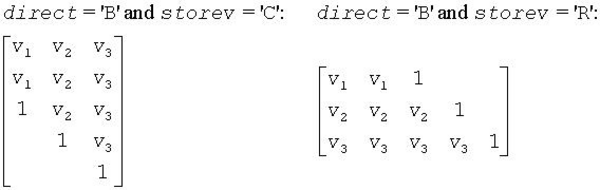
The shape of the matrix \(V\) and the storage of the vectors which define the \(H(i)\) is best illustrated by the following example with n = 5 and k = 3 . The elements equal to 1 are not stored; the corresponding array elements are modified but restored on exit. The rest of the array is not used.