Developer Reference for Intel® oneAPI Math Kernel Library for Fortran
?orcsd2by1/?uncsd2by1
Computes the CS decomposition of a block-partitioned orthogonal/unitary matrix.
Syntax
call sorcsd2by1 ( jobu1 , jobu2 , jobv1t , m , p , q , x11 , ldx11 , x21 , ldx21 , theta , u1 , ldu1 , u2 , ldu2 , v1t , ldv1t , work , lwork , iwork , info )
call dorcsd2by1 ( jobu1 , jobu2 , jobv1t , m , p , q , x11 , ldx11 , x21 , ldx21 , theta , u1 , ldu1 , u2 , ldu2 , v1t , ldv1t , work , lwork , iwork , info )
call cuncsd2by1 ( jobu1 , jobu2 , jobv1t , m , p , q , x11 , ldx11 , x21 , ldx21 , theta , u1 , ldu1 , u2 , ldu2 , v1t , ldv1t , work , lwork , rwork , lrwork , iwork , info )
call zuncsd2by1 ( jobu1 , jobu2 , jobv1t , m , p , q , x11 , ldx11 , x21 , ldx21 , theta , u1 , ldu1 , u2 , ldu2 , v1t , ldv1t , work , lwork , rwork , lrwork , iwork , info )
call orcsd2by1 ( x11 , x21 , theta , u1 , u2 , v1t [ , jobu1 ] [ , jobu2 ] [ , jobv1t ] [ , info ] )
call uncsd2by1 ( x11 , x21 , theta , u1 , u2 , v1t [ , jobu1 ] [ , jobu2 ] [ , jobv1t ] [ , info ] )
Include Files
mkl.fi , mkl_lapack.f90
Description
The routines ?orcsd2by1 / ?uncsd2by1 compute the CS decomposition of an m -by- q matrix X with orthonormal columns that has been partitioned into a 2-by-1 block structure:
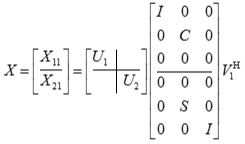
x11 is p -by- q . The orthogonal/unitary matrices u1 , u2 , v1 , and v2 are p -by- p , (m-p) -by- (m-p) , q -by- q , (m-q) -by- (m-q) , respectively. C and S are r -by- r nonnegative diagonal matrices satisfying C^{2} + S^{2} = I , in which r = min(p,m-p,q,m-q) .
Input Parameters
jobu1
CHARACTER . If equal to ‘Y’, then u1 is computed. Otherwise, u1 is not computed.
jobu2
CHARACTER . If equal to ‘Y’, then u2 is computed. Otherwise, u2 is not computed.
jobv1t
CHARACTER . If equal to ‘Y’, then v1:code:`t` is computed. Otherwise, v1:code:`t` is not computed.
m
INTEGER . The number of rows and columns of the matrix X .
p
INTEGER . The number of rows in x11 . 0 ≤p≤m .
q
INTEGER . The number of columns in x11 . 0 ≤q≤m .
- x11
-
REAL for sorcsd2by1 DOUBLE PRECISION for dorcsd2by1 COMPLEX for cuncsd2by1 DOUBLE COMPLEX for zuncsd2by1
Array, size ( ldx11 , q ) .
On entry, the part of the orthogonal matrix whose CSD is desired.
ldx11
INTEGER . The leading dimension of the array x11 . ldx11≥ max(1,p) .
- x21
-
REAL for sorcsd2by1 DOUBLE PRECISION for dorcsd2by1 COMPLEX for cuncsd2by1 DOUBLE COMPLEX for zuncsd2by1
Array, size ( ldx21 , q ) .
On entry, the part of the orthogonal matrix whose CSD is desired.
ldx21
INTEGER . The leading dimension of the array X . ldx21≥ max(1,m - p) .
ldu1
INTEGER . The leading dimension of the array u1 . If jobu1 = ‘ Y ‘, ldu1≥ max(1,p) .
ldu2
INTEGER . The leading dimension of the array u2 . If jobu2 = ‘ Y ‘, ldu2≥ max(1,m-p) .
ldv1t
INTEGER . The leading dimension of the array v1t . If jobv1t = ‘ Y ‘, ldv1t≥ max(1,q) .
- work
-
REAL for sorcsd2by1 DOUBLE PRECISION for dorcsd2by1 COMPLEX for cuncsd2by1 DOUBLE COMPLEX for zuncsd2by1 Workspace array, size ( max(1,lwork) ).
lwork
INTEGER . The size of the work array. Constraints:
If lwork = -1 , then a workspace query is assumed; the routine only calculates the optimal size of the work array, returns this value as the first entry of the work array, and no error message related to lwork is issued by xerbla .
- rwork
-
REAL for cuncsd2by1 DOUBLE PRECISION for zuncsd2by1 Workspace array, size ( max(1,lrwork) ).
lrwork
INTEGER . The size of the rwork array. Constraints:
If lrwork = -1 , then a workspace query is assumed; the routine only calculates the optimal size of the rwork array, returns this value as the first entry of the rwork array, and no error message related to lrwork is issued by xerbla .
iwork
INTEGER . Workspace array, dimension m - min(p, m - p, q, m - q) .
Output Parameters
- theta
-
REAL for sorcsd2by1 DOUBLE PRECISION for dorcsd2by1 COMPLEX for cuncsd2by1 DOUBLE COMPLEX for zuncsd2by1
Array, size ( r ) , in which r = min(p,m-p,q,m-q) .
C = diag( cos(theta(1)), ..., cos(theta(r)) ) , and S = diag( sin(theta(1)), ..., sin(theta(r)) ) .
- u1
-
REAL for sorcsd2by1 DOUBLE PRECISION for dorcsd2by1 COMPLEX for cuncsd2by1 DOUBLE COMPLEX for zuncsd2by1
Array, size ( ldu1 , p ) .
If jobu1 = ‘ Y ‘, u1 contains the p -by- p orthogonal/unitary matrix u1 .
- u2
-
REAL for sorcsd2by1 DOUBLE PRECISION for dorcsd2by1 COMPLEX for cuncsd2by1 DOUBLE COMPLEX for zuncsd2by1
Array, size ( ldu2 , m - p ) .
If jobu2 = ‘ Y ‘, u2 contains the ( m - p )-by-( m - p ) orthogonal/unitary matrix u2 .
- v1t
-
REAL for sorcsd2by1 DOUBLE PRECISION for dorcsd2by1 COMPLEX for cuncsd2by1 DOUBLE COMPLEX for zuncsd2by1
Array, size ( ldv1t , q ) .
If jobv1t = ‘ Y ‘, v1t contains the q -by- q orthogonal matrix v1:code:`T` or unitary matrix v1:code:`H` .
- work
-
On exit,
- rwork
-
On exit,
info
INTEGER .
= 0: successful exit
< 0: if info = -i , the i -th argument has an illegal value
> 0: ?orcsd2by1 / ?uncsd2by1 did not converge. See the description of work above for details.
Return Values
No return value, info is an Output Parameter.
Fortran 95 Interface Notes
Routines in Fortran 95 interface have fewer arguments in the calling sequence than their FORTRAN 77 counterparts. For general conventions applied to skip redundant or reconstructible arguments, see Fortran 95 Interface Conventions .
Specific details for the routine ?orcsd2by1/?orcsd2by1 interface are as follows:
x11
Holds the block of matrix X11 of size ( p , q ).
x21
Holds the block of matrix X21 of size ( m - p , q ).
theta
Holds the vector of length r = min(p,m-p,q,m-q) .
u1
Holds the matrix u1 of size ( p , p ).
u2
Holds the matrix u2 of size ( m - p , m - p ).
v1t
Holds the matrix v1T or v1H of size ( q , q ).
jobu1
Indicates whether u1 is computed. Must be ‘Y’ or ‘O’ .
jobu2
Indicates whether u2 is computed. Must be ‘Y’ or ‘O’ .
jobv1t
Indicates whether v1:code:`t` is computed. Must be ‘Y’ or ‘O’ .