Developer Reference for Intel® oneAPI Math Kernel Library for Fortran
?ggsvd
Computes the generalized singular value decomposition of a pair of general rectangular matrices (deprecated).
Syntax
call sggsvd ( jobu , jobv , jobq , m , n , p , k , l , a , lda , b , ldb , alpha , beta , u , ldu , v , ldv , q , ldq , work , iwork , info )
call dggsvd ( jobu , jobv , jobq , m , n , p , k , l , a , lda , b , ldb , alpha , beta , u , ldu , v , ldv , q , ldq , work , iwork , info )
call cggsvd ( jobu , jobv , jobq , m , n , p , k , l , a , lda , b , ldb , alpha , beta , u , ldu , v , ldv , q , ldq , work , rwork , iwork , info )
call zggsvd ( jobu , jobv , jobq , m , n , p , k , l , a , lda , b , ldb , alpha , beta , u , ldu , v , ldv , q , ldq , work , rwork , iwork , info )
call ggsvd ( a , b , alpha , beta [ , k ] [ , l ] [ , u ] [ , v ] [ , q ] [ , iwork ] [ , info ] )
Include Files
mkl.fi , mkl_lapack.f90
Description
sggsvd dggsvd cggsvd zggsvd ggsvd This routine is deprecated; use ggsvd3 (Computes generalized SVD.) .
The routine computes the generalized singular value decomposition (GSVD) of an m -by- n real/complex matrix A and p -by- n real/complex matrix B :
U'*A*Q = D_{1}*(0 R) , V'*B*Q = D_{2}*(0 R) ,
where U , V and Q are orthogonal/unitary matrices and U' , V' mean transpose/conjugate transpose of U and V respectively.
Let k + l = the effective numerical rank of the matrix ( A' , B' )’, then R is a ( k + l )-by-( k + l ) nonsingular upper triangular matrix, D1 and D2 are m -by-( k + l ) and p -by-( k + l ) “diagonal” matrices and of the following structures, respectively:
If m - k-l ≥ 0,

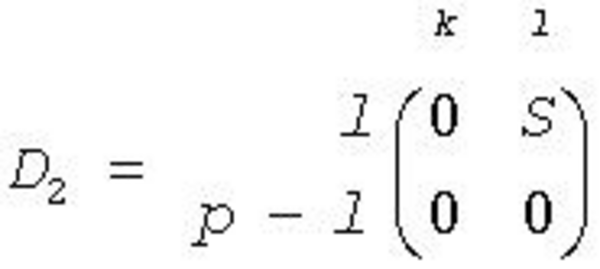

where
C = diag(alpha(K+1),..., alpha(K+l)alpha[k],..., alpha[k + l - 1])
S = diag(beta(K+1),...,beta(K+l)beta[k],...,beta[k + l - 1])
C^{2} + S^{2} = I
R is stored in a (1: k + l , n - k - l +1: n ) on exit.
Nonzero element ri j (1 ≤ i ≤ j ≤ k + l ) of R is stored in a[(i - 1) + (n - k - l + j - 1)*lda] for column major layout and in a[(i - 1)*lda + (n - k - l + j - 1)] for row major layout.
If m-k-l < 0 ,

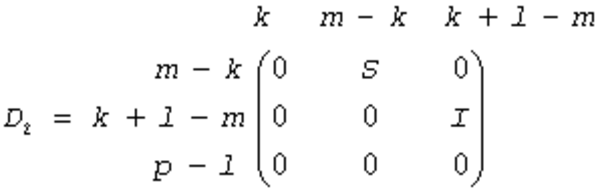
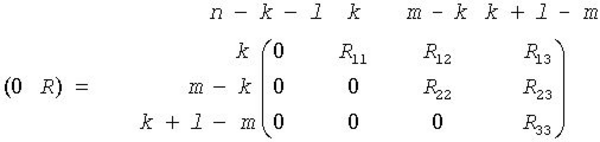
where
C = diag(alpha(K+1),..., alpha(m)alpha[k],..., alpha(m)) ,
S = diag(beta(K+1),...,beta(m)beta[k],...,beta[m - 1]) ,
:code:`C2 + S2 = I`
On exit,

is stored in a (1: m , n - k - l +1: n ) and R33 is stored in b ( m - k +1: l , n + m - k - l +1: n ).
On exit, the location of nonzero element ri j (1 ≤ i ≤ j ≤ k + l ) of R depends on the value of i . For i ≤ m this element is stored in a[(i - 1) + (n - k - l + j - 1)*lda] for column major layout and in a[(i - 1)*lda + (n - k - l + j - 1)] for row major layout. For m < i ≤ k + l it is stored in b[(i - k - 1) + (n - k - l + j - 1)*ldb] for column major layout and in b[(i - k - 1)*ldb + (n - k - l + j - 1)] for row major layout.
The routine computes C , S , R , and optionally the orthogonal/unitary transformation matrices U , V and Q .
In particular, if B is an n -by- n nonsingular matrix, then the GSVD of A and B implicitly gives the SVD of A * B-1 :
A*B^{-1} = U*(D_{1}*D_{2}^{-1})*V' .
If ( A ‘, B ‘)’ has orthonormal columns, then the GSVD of A and B is also equal to the CS decomposition of A and B . Furthermore, the GSVD can be used to derive the solution of the eigenvalue problem:
A'**A*x = λ*B'*B*x .
Input Parameters
jobu
CHARACTER*1 . Must be ‘U’ or ‘N’ .
If jobu = 'U' , orthogonal/unitary matrix U is computed. If jobu = 'N' , U is not computed.
jobv
CHARACTER*1 . Must be ‘V’ or ‘N’ .
If jobv = 'V' , orthogonal/unitary matrix V is computed. If jobv = 'N' , V is not computed.
jobq
CHARACTER*1 . Must be ‘Q’ or ‘N’ .
If jobq = 'Q' , orthogonal/unitary matrix Q is computed. If jobq = 'N' , Q is not computed.
m
INTEGER . The number of rows of the matrix A ( m≥ 0 ).
n
INTEGER . The number of columns of the matrices A and B ( n≥ 0 ).
p
INTEGER . The number of rows of the matrix B ( p≥ 0 ).
- a , b , work
-
REAL for sggsvd DOUBLE PRECISION for dggsvd COMPLEX for cggsvd DOUBLE COMPLEX for zggsvd . Arrays:
a ( lda ,*) contains the m -by- n matrix A .
The second dimension of a must be at least max(1, n ).
b ( ldb ,*) contains the p -by- n matrix B .
The second dimension of b must be at least max(1, n ). work (*) is a workspace array. The dimension of work must be at least max(3 n , m , p )+ n .
lda
INTEGER . The leading dimension of a ; at least max(1, m ) .
ldb
INTEGER . The leading dimension of b ; at least max(1, p ) .
ldu
INTEGER . The leading dimension of the array u .
ldu≥ max (1, m ) if jobu = 'U' ; ldu≥ 1 otherwise.
ldv
INTEGER . The leading dimension of the array v .
ldv≥ max (1, p ) if jobv = 'V' ; ldv≥ 1 otherwise.
ldq
INTEGER . The leading dimension of the array q .
ldq≥ max (1, n ) if jobq = 'Q' ; ldq≥ 1 otherwise.
iwork
INTEGER .
Workspace array, size at least max(1, n ).
- rwork
-
REAL for cggsvd DOUBLE PRECISION for zggsvd . Workspace array, size at least max(1, 2 n ). Used in complex flavors only.
Output Parameters
k , l
INTEGER . On exit, k and l specify the dimension of the subblocks. The sum k+l is equal to the effective numerical rank of ( A' , B' )’.
- a
-
On exit, a contains the triangular matrix R or part of R .
- b
-
On exit, b contains part of the triangular matrix R if m-k-l < 0 .
- alpha , beta
-
REAL for single-precision flavors DOUBLE PRECISION for double-precision flavors. Arrays, size at least max(1, n ) each. Contain the generalized singular value pairs of A and B : alpha(1:k) = 1 , beta(1:k) = 0 , and if m-k-l≥ 0 , alpha(k+1:k+l) = C , beta(k+1:k+l) = S , or if m-k-l < 0 , alpha(k+1:m)= C , alpha(m+1:k+l)=0beta(k+1:m) = S , beta(m+1:k+l) = 1 and alpha(k+l+1:n) = 0beta(k+l+1:n) = 0 .
- u , v , q
-
REAL for sggsvd DOUBLE PRECISION for dggsvd COMPLEX for cggsvd DOUBLE COMPLEX for zggsvd . Arrays:
u ( ldu ,*); the second dimension of u must be at least max(1, m ) .
If jobu = 'U' , u contains the m -by- m orthogonal/unitary matrix U . If jobu = 'N' , u is not referenced.
v ( ldv ,*); the second dimension of v must be at least max(1, p ) .
If jobv = 'V' , v contains the p -by- p orthogonal/unitary matrix V . If jobv = 'N' , v is not referenced.
q ( ldq ,*); the second dimension of q must be at least max(1, n ) .
If jobq = 'Q' , q contains the n -by- n orthogonal/unitary matrix Q . If jobq = 'N' , q is not referenced.
- iwork
-
On exit, iwork stores the sorting information.
info
INTEGER .
If info = 0 , the execution is successful.
If info = -i , the i -th parameter had an illegal value.
If info = 1 , the Jacobi-type procedure failed to converge. For further details, see subroutine tgsja .
Return Values
No return value, info is an Output Parameter.
LAPACK 95 Interface Notes
Routines in Fortran 95 interface have fewer arguments in the calling sequence than their FORTRAN 77 counterparts. For general conventions applied to skip redundant or restorable arguments, see LAPACK 95 Interface Conventions .
Specific details for the routine ggsvd interface are the following:
a
Holds the matrix A of size ( m , n ).
b
Holds the matrix B of size ( p , n ).
alpha
Holds the vector of length n .
beta
Holds the vector of length n .
u
Holds the matrix U of size ( m , m ).
v
Holds the matrix V of size ( p , p ).
q
Holds the matrix Q of size ( n , n ).
iwork
Holds the vector of length n .
jobu
Restored based on the presence of the argument u as follows:
jobu = 'U' , if u is present, jobu = 'N' , if u is omitted.
jobv
Restored based on the presence of the argument v as follows:
jobz = 'V' , if v is present,
jobz = 'N' , if v is omitted.
jobq
Restored based on the presence of the argument q as follows:
jobz = 'Q' , if q is present,
jobz = 'N' , if q is omitted.