Developer Reference for Intel® oneAPI Math Kernel Library for Fortran
?gglse
Solves the linear equality-constrained least squares problem using a generalized RQ factorization.
Syntax
call sgglse ( m , n , p , a , lda , b , ldb , c , d , x , work , lwork , info )
call dgglse ( m , n , p , a , lda , b , ldb , c , d , x , work , lwork , info )
call cgglse ( m , n , p , a , lda , b , ldb , c , d , x , work , lwork , info )
call zgglse ( m , n , p , a , lda , b , ldb , c , d , x , work , lwork , info )
call gglse ( a , b , c , d , x [ , info ] )
Include Files
mkl.fi , mkl_lapack.f90
Description
sgglse dgglse cgglse zgglse gglse
The routine solves the linear equality-constrained least squares (LSE) problem:
minimize ||c - A*x||_{2} subject to B*x = d
where A is an m -by- n matrix, B is a p -by- n matrix, c is a given m -vector, and d is a given p -vector. It is assumed that p≤n≤m+p , and

These conditions ensure that the LSE problem has a unique solution, which is obtained using a generalized RQ factorization of the matrices (B, A) given by
B =(0 R )* Q , A = Z * T * Q
Input Parameters
m
INTEGER . The number of rows of the matrix A ( m≥ 0 ).
n
INTEGER . The number of columns of the matrices A and B ( n≥ 0 ).
p
INTEGER . The number of rows of the matrix B
( 0 ≤p≤n≤m+p) .
- a , b , c , d , work
-
REAL for sgglse DOUBLE PRECISION for dgglse COMPLEX for cgglse DOUBLE COMPLEX for zgglse . Arrays:
a ( lda ,*) contains the m -by- n matrix A .
The second dimension of a must be at least max(1, n ).
b ( ldb ,*) contains the p -by- n matrix B .
The second dimension of b must be at least max(1, n ).
c (* ), size at least max(1, m ), contains the right hand side vector for the least squares part of the LSE problem.
d (* ), , size at least max(1, p ), contains the right hand side vector for the constrained equation.
work is a workspace array, its dimension max(1, lwork) .
lda
INTEGER . The leading dimension of a ; at least max(1, m ) .
ldb
INTEGER . The leading dimension of b ; at least max(1, p ) .
lwork
INTEGER . The size of the work array;
lwork≥ max(1, m+n+p) . If lwork = -1 , then a workspace query is assumed; the routine only calculates the optimal size of the work array, returns this value as the first entry of the work array, and no error message related to lwork is issued by xerbla . See Application Notes for the suggested value of lwork .
Output Parameters
- a
-
The elements on and above the diagonal contain the min( m , n )-by- n upper trapezoidal matrix T as returned by ?ggrqf .
- x
-
REAL for sgglse The solution of the LSE problem.
b
On exit, the upper right triangle of the subarray b(1:p, n-p+1:n) contains the p -by- p upper triangular matrix R as returned by ?ggrqf .
- d
-
On exit, d is destroyed.
- c
-
On exit, the residual sum-of-squares for the solution is given by the sum of squares of elements n - p +1 to m of vector c .
- work(1)
-
If info = 0 , on exit, work(1) contains the minimum value of lwork required for optimum performance. Use this lwork for subsequent runs.
info
INTEGER .
If info = 0 , the execution is successful.
If info = -i , the i -th parameter had an illegal value.
If info = 1 , the upper triangular factor R associated with B in the generalized RQ factorization of the pair (B, A) is singular, so that rank(B) < p ; the least squares solution could not be computed.
If info = 2 , the (n-p) -by- (n-p) part of the upper trapezoidal factor T associated with A in the generalized RQ factorization of the pair (B, A) is singular, so that
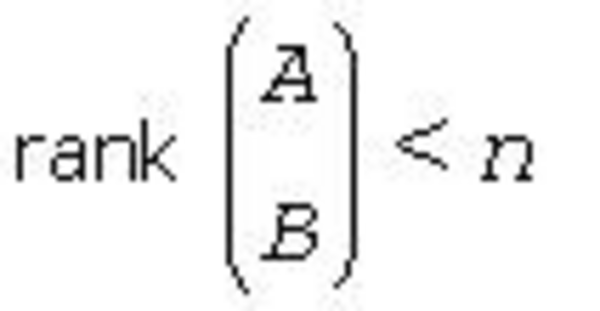
; the least squares solution could not be computed.
Return Values
No return value, info is an Output Parameter.
LAPACK 95 Interface Notes
Routines in Fortran 95 interface have fewer arguments in the calling sequence than their FORTRAN 77 counterparts. For general conventions applied to skip redundant or restorable arguments, see LAPACK 95 Interface Conventions .
Specific details for the routine gglse interface are the following:
a
Holds the matrix A of size ( m,n ).
b
Holds the matrix B of size ( p,n ).
c
Holds the vector of length ( m ).
d
Holds the vector of length ( p ).
x
Holds the vector of length n .
Application Notes
For optimum performance, use
lwork≥p + min(m, n) + max(m, n)*nb ,
where nb is an upper bound for the optimal blocksizes for ?geqrf , ?gerqf , ?ormqr / ?unmqr and ?ormrq / ?unmrq .
You may set lwork to -1. The routine returns immediately and provides the recommended workspace in the first element of the corresponding array ( work ). This operation is called a workspace query.
Note that if you set lwork to less than the minimal required value and not -1, the routine returns immediately with an error exit and does not provide any information on the recommended workspace.