Developer Reference for Intel® oneAPI Math Kernel Library for Fortran
?lahrd
Reduces the first nb columns of a general rectangular matrix A so that elements below the k -th subdiagonal are zero, and returns auxiliary matrices which are needed to apply the transformation to the unreduced part of A (deprecated).
Syntax
call slahrd ( n , k , nb , a , lda , tau , t , ldt , y , ldy )
call dlahrd ( n , k , nb , a , lda , tau , t , ldt , y , ldy )
call clahrd ( n , k , nb , a , lda , tau , t , ldt , y , ldy )
call zlahrd ( n , k , nb , a , lda , tau , t , ldt , y , ldy )
Include Files
mkl.fi
Description
slahrd dlahrd clahrd zlahrd This routine is deprecated; use lahr2 (Reduces the specified number of first columns of a general rectangular matrix A so that elements below the specified subdiagonal are zero, and returns auxiliary matrices which are needed to apply the transformation to the unreduced part of A.) .
The routine reduces the first nb columns of a real/complex general n -by-( n - k +1) matrix A so that elements below the k -th subdiagonal are zero. The reduction is performed by an orthogonal/unitary similarity transformation Q:code:`T` * A * Q for real flavors, or Q:code:`H` * A * Q for complex flavors. The routine returns the matrices V and T which determine Q as a block reflector I - V * T * V:code:`T` (for real flavors) or I - V * T * V:code:`H` (for complex flavors), and also the matrix Y = A * V * T .
The matrix Q is represented as products of nb elementary reflectors:
Q = H(1)*H(2)*... *H(nb)
Each H(i) has the form
H(i) = I - tau*v*v^{T} for real flavors, or
H(i) = I - tau*v*v^{H} for complex flavors, or
where tau is a real/complex scalar, and v is a real/complex vector.
Input Parameters
- n
-
INTEGER . The order of the matrix A ( n≥ 0 ).
- k
-
INTEGER . The offset for the reduction. Elements below the k -th subdiagonal in the first nb columns are reduced to zero.
- nb
-
INTEGER . The number of columns to be reduced.
- a
-
REAL for slahrd DOUBLE PRECISION for dlahrd COMPLEX for clahrd DOUBLE COMPLEX for zlahrd . Array a ( lda , n - k +1) contains the n -by-( n - k +1) general matrix A to be reduced.
- lda
-
INTEGER . The leading dimension of a ; at least max(1, n) .
- ldt
-
INTEGER . The leading dimension of the output array t ; must be at least max(1, nb) .
- ldy
-
INTEGER . The leading dimension of the output array y ; must be at least max(1, n) .
Output Parameters
- a
-
On exit, the elements on and above the k -th subdiagonal in the first nb columns are overwritten with the corresponding elements of the reduced matrix; the elements below the k -th subdiagonal, with the array tau , represent the matrix Q as a product of elementary reflectors. The other columns of a are unchanged. See Application Notes below.
- tau
-
REAL for slahrd DOUBLE PRECISION for dlahrd COMPLEX for clahrd DOUBLE COMPLEX for zlahrd . Array, DIMENSION ( nb ). Contains scalar factors of the elementary reflectors.
- t , y
-
REAL for slahrd DOUBLE PRECISION for dlahrd COMPLEX for clahrd DOUBLE COMPLEX for zlahrd . Arrays, dimension t ( ldt , nb ), y ( ldy , nb ). The array t contains upper triangular matrix T . The array y contains the n -by- nb matrix Y .
Application Notes
For the elementary reflector \(H\) (i),
v(1:i+k-1) = 0 , v(i+k) = 1 ; v(i+k+1:n) is stored on exit in a (i+ k +1: n , i) and tau is stored in tau (i).
The elements of the vectors v together form the ( n - k +1)-by- nb matrix \(V\) which is needed, with \(T\) and \(Y\) , to apply the transformation to the unreduced part of the matrix, using an update of the form:
\(A := (I - V T V^{T}) (A - Y V^{T})\) for real flavors, or
\(A := (I - V T V^{H}) (A - Y V^{H})\) for complex flavors.
The contents of \(A\) on exit are illustrated by the following example with n = 7 , k = 3 and nb = 2 :
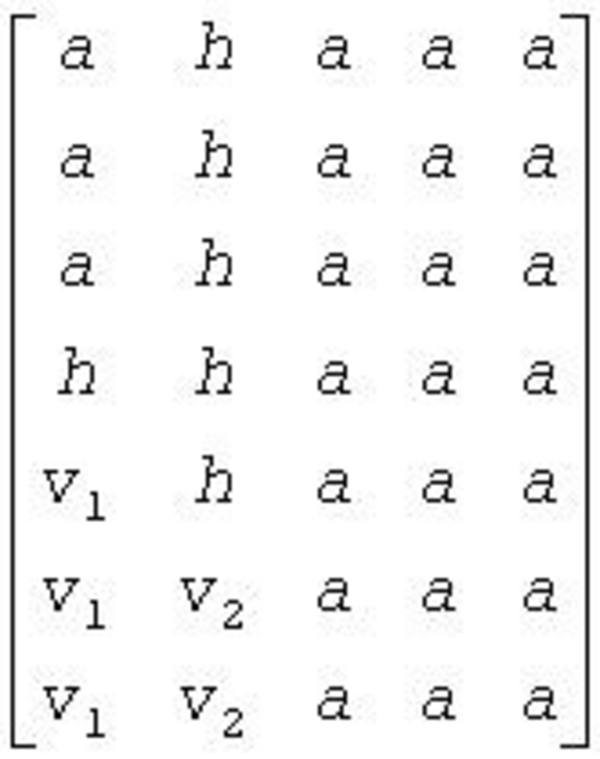
where a denotes an element of the original matrix \(A\) , h denotes a modified element of the upper Hessenberg matrix \(H\) , and vi denotes an element of the vector defining \(H\) (i).