Developer Reference for Intel® oneAPI Math Kernel Library for C
?hseqr
Computes all eigenvalues and (optionally) the Schur factorization of a matrix reduced to Hessenberg form.
Syntax
lapack_int LAPACKE_shseqr ( intmatrix_layout , charjob , charcompz , lapack_intn , lapack_intilo , lapack_intihi , float*h , lapack_intldh , float*wr , float*wi , float*z , lapack_intldz );
lapack_int LAPACKE_dhseqr ( intmatrix_layout , charjob , charcompz , lapack_intn , lapack_intilo , lapack_intihi , double*h , lapack_intldh , double*wr , double*wi , double*z , lapack_intldz );
lapack_int LAPACKE_chseqr ( intmatrix_layout , charjob , charcompz , lapack_intn , lapack_intilo , lapack_intihi , lapack_complex_float*h , lapack_intldh , lapack_complex_float*w , lapack_complex_float*z , lapack_intldz );
lapack_int LAPACKE_zhseqr ( intmatrix_layout , charjob , charcompz , lapack_intn , lapack_intilo , lapack_intihi , lapack_complex_double*h , lapack_intldh , lapack_complex_double*w , lapack_complex_double*z , lapack_intldz );
Include Files
mkl.h
Description
The routine computes all the eigenvalues, and optionally the Schur factorization, of an upper Hessenberg matrix H : H = Z*T*Z^{H} , where T is an upper triangular (or, for real flavors, quasi-triangular) matrix (the Schur form of H ), and Z is the unitary or orthogonal matrix whose columns are the Schur vectors zi .
You can also use this routine to compute the Schur factorization of a general matrix A which has been reduced to upper Hessenberg form H :
A = Q*H*Q^{H} , where Q is unitary (orthogonal for real flavors);
A = (QZ)*T*(QZ)^{H} .
In this case, after reducing A to Hessenberg form by gehrd , call orghr to form Q explicitly and then pass Q to ?hseqr with compz = 'V' .
You can also call gebal to balance the original matrix before reducing it to Hessenberg form by ?hseqr , so that the Hessenberg matrix H will have the structure:
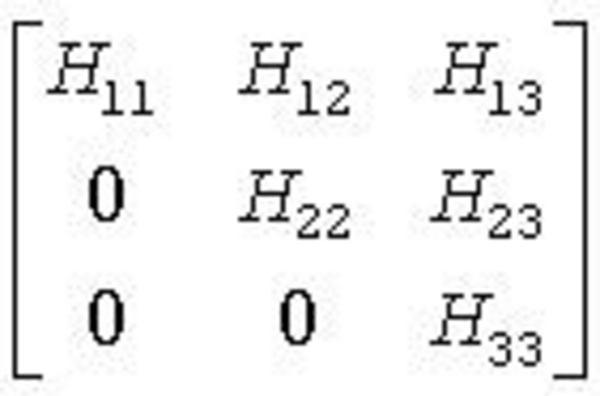
where H11 and H33 are upper triangular.
If so, only the central diagonal block H22 (in rows and columns ilo to ihi ) needs to be further reduced to Schur form (the blocks H12 and H23 are also affected). Therefore the values of ilo and ihi can be supplied to ?hseqr directly. Also, after calling this routine you must call gebak to permute the Schur vectors of the balanced matrix to those of the original matrix.
If ?gebal has not been called, however, then ilo must be set to 1 and ihi to n . Note that if the Schur factorization of A is required, ?gebal must not be called with job = 'S' or ‘B’ , because the balancing transformation is not unitary (for real flavors, it is not orthogonal).
?hseqr uses a multishift form of the upper Hessenberg QR algorithm. The Schur vectors are normalized so that ||z_{i}||_{2} = 1 , but are determined only to within a complex factor of absolute value 1 (for the real flavors, to within a factor ± 1).
Input Parameters
job
Must be ‘E’ or ‘S’ .
If job = 'E' , then eigenvalues only are required. If job = 'S' , then the Schur form T is required.
compz
Must be ‘N’ or ‘I’ or ‘V’ .
If compz = ‘N’ , then no Schur vectors are computed (and the array z is not referenced). If compz = ‘I’ , then the Schur vectors of H are computed (and the array z is initialized by the routine). If compz = ‘V’ , then the Schur vectors of A are computed (and the array z must contain the matrix Q on entry).
n
The order of the matrix H ( n≥ 0 ).
ilo , ihi
If A has been balanced by ?gebal , then ilo and ihi must contain the values returned by ?gebal . Otherwise, ilo must be set to 1 and ihi to n .
- h , z , work
-
REAL for shseqr DOUBLE PRECISION for dhseqr COMPLEX for chseqr DOUBLE COMPLEX for zhseqr . Arrays:
h (size max(1, ldh * n )) ) The n -by- n upper Hessenberg matrix H .
The second dimension of h must be at least max(1, n ).
z (size max(1, ldz * n ))
If compz = 'V' , then z must contain the matrix Q from the reduction to Hessenberg form. If compz = 'I' , then z need not be set. If compz = 'N' , then z is not referenced. The second dimension of z must be at least max(1, n ) if compz = 'V' or ‘I’ ; at least 1 if compz = 'N' . work ( lwork ) is a workspace array. The dimension of work must be at least max (1, n ).
ldh
The leading dimension of h ; at least max(1, n ).
ldz
The leading dimension of z ;
If compz = 'N' , then ldz≥ 1 . If compz = 'V' or ‘I’ , then ldz≥ max(1, n) .
lwork
The dimension of the array work .
lwork≥ max(1, n) is sufficient and delivers very good and sometimes optimal performance. However, lwork as large as 11*n may be required for optimal performance. A workspace query is recommended to determine the optimal workspace size. If lwork = -1 , then a workspace query is assumed; the routine only estimates the optimal size of the work array, returns this value as the first entry of the work array, and no error message related to lwork is issued by xerbla . See Application Notes for details.
Output Parameters
- w
-
COMPLEX for chseqr DOUBLE COMPLEX for zhseqr . Array, size at least max (1, n ). Contains the computed eigenvalues, unless info >0. The eigenvalues are stored in the same order as on the diagonal of the Schur form T (if computed).
- wr , wi
-
REAL for shseqr DOUBLE PRECISION for dhseqr Arrays, size at least max (1, n ) each. Contain the real and imaginary parts, respectively, of the computed eigenvalues, unless info > 0 . Complex conjugate pairs of eigenvalues appear consecutively with the eigenvalue having positive imaginary part first. The eigenvalues are stored in the same order as on the diagonal of the Schur form T (if computed).
- h
-
If info = 0 and job = 'S' , h contains the upper quasi-triangular matrix T from the Schur decomposition (the Schur form). If info = 0 and job = 'E' , the contents of h are unspecified on exit. (The output value of h when info > 0 is given under the description of info below.)
- z
-
If compz = 'V' and info = 0 , then z contains Q*Z . If compz = 'I' and info = 0 , then z contains the unitary or orthogonal matrix Z of the Schur vectors of H . If compz = 'N' , then z is not referenced.
- work(1)
-
On exit, if info = 0 , then work(1) returns the optimal lwork .
Return Values
This function returns a value info .
If info = 0 , the execution is successful.
If info = -i , the i -th parameter had an illegal value.
If info = i , ?hseqr failed to compute all of the eigenvalues. Elements 1,2, …, ilo -1 and i +1, i +2, …, n of the eigenvalue arrays ( wr and wi for real flavors and w for complex flavors) contain the real and imaginary parts of those eigenvalues that have been successfully found.
If info > 0 , and job = 'E' , then on exit, the remaining unconverged eigenvalues are the eigenvalues of the upper Hessenberg matrix rows and columns ilo through info of the final output value of H .
If info > 0 , and job = 'S' , then on exit (initial value of H )* U = U *(final value of H ), where U is a unitary matrix. The final value of H is upper Hessenberg and triangular in rows and columns info+1 through ihi .
If info > 0 , and compz = 'V' , then on exit (final value of Z ) = (initial value of Z )* U , where U is the unitary matrix (regardless of the value of job ).
If info > 0 , and compz = 'I' , then on exit (final value of Z ) = U , where U is the unitary matrix (regardless of the value of job ).
If info > 0 , and compz = 'N' , then Z is not accessed.
LAPACK 95 Interface Notes
There exist FORTRAN 77 and FORTRAN 95 interfaces for this routine. See the Intel® oneMKL Fortran Developer Reference for details.
Application Notes
The computed Schur factorization is the exact factorization of a nearby matrix \(H + E\) , where \(||E||_{2} < O(\varepsilon) ||H||_{2}/s_{i}\) , and \(\varepsilon\) is the machine precision.
If λ i is an exact eigenvalue, and μ i is the corresponding computed value, then \(|\lambda_{i} - \mu_{i}|\leq c(n) \varepsilon ||H||_{2}/s_{i}\) , where c(n) is a modestly increasing function of n , and si is the reciprocal condition number of λ i . The condition numbers si may be computed by calling trsna .
The total number of floating-point operations depends on how rapidly the algorithm converges; typical numbers are as follows.
If only eigenvalues are computed:
\(7n^{3}\) for real flavors
\(25n^{3}\) for complex flavors.
If the Schur form is computed:
\(10n^{3}\) for real flavors
\(35n^{3}\) for complex flavors.
If the full Schur factorization is computed:
\(20n^{3}\) for real flavors
\(70n^{3}\) for complex flavors.