Developer Reference for Intel® oneAPI Math Kernel Library for Fortran
A newer version of this document is available. Customers should click here to go to the newest version.
?lahef
Computes a partial factorization of a complex Hermitian indefinite matrix, using the diagonal pivoting method.
Syntax
call clahef( uplo, n, nb, kb, a, lda, ipiv, w, ldw, info )
call zlahef( uplo, n, nb, kb, a, lda, ipiv, w, ldw, info )
Include Files
- mkl.fi
Description
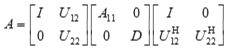
The routine ?lahef computes a partial factorization of a complex Hermitian matrix A, using the Bunch-Kaufman diagonal pivoting method. The partial factorization has the form:
If uplo = 'U':
If uplo = 'U':
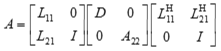
where the order of D is at most nb.
The actual order is returned in the argument kb, and is either nb or nb-1, or n if n ≤ nb.
Note that UH denotes the conjugate transpose of U.
This is an auxiliary routine called by ?hetrf. It uses blocked code (calling Level 3 BLAS) to update the submatrix A11 (if uplo = 'U') or A22 (if uplo = 'L').
Input Parameters
- uplo
-
CHARACTER*1.
Specifies whether the upper or lower triangular part of the Hermitian matrix A is stored:
= 'U': upper triangular
= 'L': lower triangular
- n
-
INTEGER. The order of the matrix A. n≥ 0.
- nb
-
INTEGER. The maximum number of columns of the matrix A that should be factored. nb should be at least 2 to allow for 2-by-2 pivot blocks.
- a
-
COMPLEX for clahef
DOUBLE COMPLEX for zlahef.
Array, DIMENSION (lda, n).
On entry, the Hermitian matrix A.
If uplo = 'U', the leading n-by-n upper triangular part of A contains the upper triangular part of the matrix A, and the strictly lower triangular part of A is not referenced.
If uplo = 'L', the leading n-by-n lower triangular part of A contains the lower triangular part of the matrix A, and the strictly upper triangular part of A is not referenced.
- lda
-
INTEGER. The leading dimension of the array a. lda≥ max(1,n).
- w
-
COMPLEX for clahef
DOUBLE COMPLEX for zlahef.
Workspace array, DIMENSION (ldw, nb).
- ldw
-
INTEGER. The leading dimension of the array w. ldw≥ max(1,n).
Output Parameters
- kb
-
INTEGER. The number of columns of A that were actually factored kb is either nb-1 or nb, or n if n ≤ nb.
- a
-
On exit, A contains details of the partial factorization.
- ipiv
-
INTEGER.
Array, DIMENSION (n ). Details of the interchanges and the block structure of D.
If uplo = 'U', only the last kb elements of ipiv are set;
if uplo = 'L', only the first kb elements are set.
If ipiv(k) > 0, then rows and columns k and ipiv(k) are interchanged and D(k, k) is a 1-by-1 diagonal block.
If uplo = 'U' and ipiv(k) = ipiv(k-1) < 0, then rows and columns k-1 and -ipiv(k) are interchanged and D(k-1:k, k-1:k) is a 2-by-2 diagonal block.
If uplo = 'L' and ipiv(k) = ipiv(k+1) < 0, then rows and columns k+1 and -ipiv(k) are interchanged and D( k:k+1, k:k+1) is a 2-by-2 diagonal block.
- info
-
INTEGER.
= 0: successful exit
> 0: if info = k, D(k, k) is exactly zero. The factorization has been completed, but the block diagonal matrix D is exactly singular.