skip_ahead
Proceeds the state of the engine using the skip-ahead method. The skip_ahead function supports the following interfaces to apply the skip-ahead method:
Common interface
Interface with a partitioned number of skipped elements
Description
The skip_ahead function advances the state of the given engine as if it had generated 32 random bits a specified number of times. This feature is particularly useful in distributing random numbers from original engine across different computational nodes. If the largest number of random numbers used by a computational node is num_to_skip, then the original random sequence may be split by skip_ahead into non-overlapping blocks of num_to_skip size so that each block corresponds to the respective computational node. The number of computational nodes is unlimited. This method is known as the block-splitting method or as the skip-ahead method (see the following figure).
Block-Splitting Method
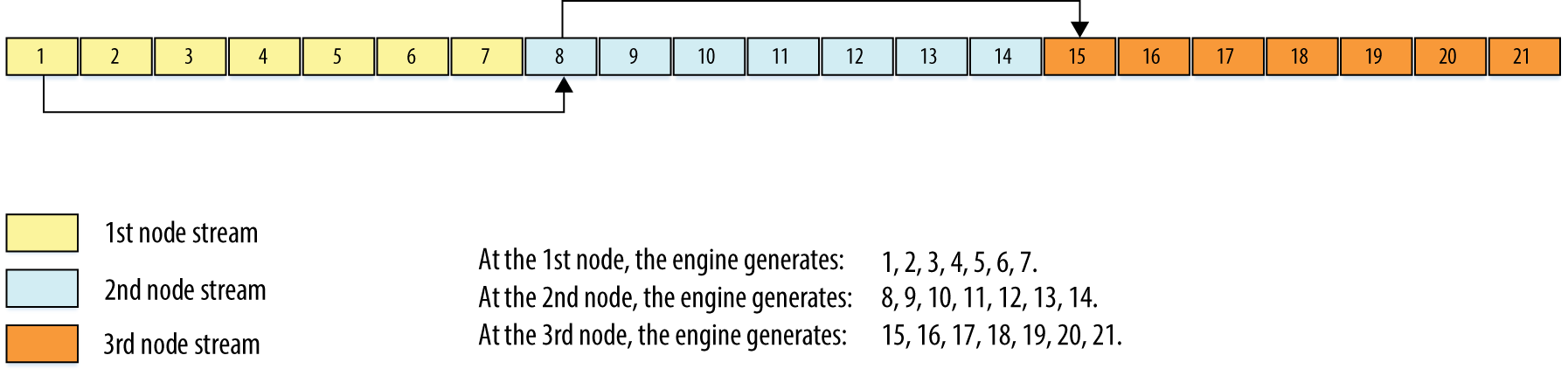
The skip-ahead method is supported only for those basic generators that allow skipping elements by the skip-ahead method, which is more efficient than simply generating them by generator with subsequent manual skipping. See VS Notes for details.
Please note that for quasi-random basic generators the skip-ahead method works with components of quasi-random vectors rather than with whole quasi-random vectors. Therefore, to skip NS quasi-random vectors, set the num_to_skip parameter equal to the num_to_skip *dim, where dim is the dimension of the quasi-random vector.
When the number of skipped elements is greater than \(2^{63}\) the interface with the partitioned number of skipped elements is used.
Prior calls to the function represent the number of skipped elements with the list of size n as shown below:
num_to_skip[0]+ num_to_skip[1]*264+ num_to_skip[2]* 2128+ … +num_to_skip[n-1]*264*(n-1) ;
When the number of skipped elements is less than \(2^{63}\) both interfaces can be used.
The following code illustrates how to initialize three independent streams using the skip_ahead function:
Code for Block-Splitting Method
   ...
   // Creating 3 identical engines
   oneapi::mkl::rng::mcg31m1 engine_1(queue, seed);
   oneapi::mkl::rng::mcg31m1 engine_2(engine_1);
   oneapi::mkl::rng::mcg31m1 engine_3(engine_2);


   // Skipping ahead by 7 elements the 2nd engine
   oneapi::mkl::rng::skip_ahead(engine_2, 7);


   // Skipping ahead by 14 elements the 3nd engine
   oneapi::mkl::rng::skip_ahead(engine_3, 14);
   ...
Code for Block-Splitting Method with Partitioned Number of Elements
   // Creating first engine
   oneapi::mkl::rng::mrg32k3a engine_1(queue, seed);


   // To skip 2^64 elements in the random stream number of skipped elements should be
   /represented as num_to_skip = 2^64 = 0 + 1 * 2^64
   std::initializer_list<std::uint64_t> num_to_skip = {0, 1};


   // Creating the 2nd engine based on 1st. Skipping by 2^64
   oneapi::mkl::rng::mrg32k3a engine_2(engine_1);
   oneapi::mkl::rng::skip_ahead(engine_2, num_to_skip);


   // Creating the 3rd engine based on 2nd. Skipping by 2^64
   oneapi::mkl::rng::mrg32k3a engine_3(engine_2);
   oneapi::mkl::rng::skip_ahead(engine_3, num_to_skip);
   ...
API
Syntax
Common Interface
namespace oneapi::mkl::rng {
  template<typename Engine>
  void skip_ahead (Engine& engine,
                   std::uint64_t num_to_skip)
}
Interface with Partitioned Number of Skipped Elements
namespace oneapi::mkl::rng {
template<typename Engine>
void skip_ahead (Engine& engine,
                 std::initializer_list<std::uint64_t> num_to_skip)
}
Include Files
oneapi/mkl/rng.hpp
Input Parameters
Common Interface
Name |
Type |
Description |
|---|---|---|
engine |
Engine |
Object of engine class, which supports the block-splitting method. |
num_to_skip |
std::uint64_t |
Number of skipped elements. |
Interface with Partitioned Number of Skipped Elements
Name |
Type |
Description |
|---|---|---|
engine |
Engine |
Object of engine class, which supports the block-splitting method. |
num_to_skip |
std::initializer_list<std::uint64_t> |
Partitioned number of skipped elements. |