erf
Computes the element-wise error function of vector elements.
Description
The erf function computes the error function values for elements of the input vector a and writes them to the output vector y.
The error function is defined as given by:
\[\mathrm{erf} (x) = \frac{2}{\sqrt{\pi}} \int_0^x e^{-t^2}dt\]
Useful relations:
\[\mathrm{erfc} (x) = 1 - \mathrm{erf} (x)\]
where erfc is the complementary error function.
\[\Phi (x) = \frac{1}{2} \mathrm{erf} (\frac{x}{\sqrt{2}})\]
where
\[\Phi (x) = - \frac{1}{\sqrt{2\pi}} \int_0^x \exp (- frac{t^2}{2}) dt\]
is the cumulative normal distribution function.
\[\Phi^{-1} (x) = \sqrt{2} \mathrm{erf}^{-1} (2x - 1)\]
where \(\phi -1(x)\) and erf-1(x) are the inverses to \(\phi (x)\) and erf(x), respectively.
The following figure illustrates the relationships among erf family functions (erf, erfc, cdfnorm).
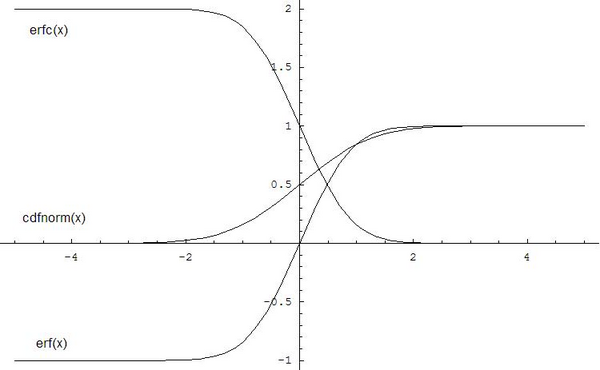
Useful relations for these functions:
\[\mathrm{erf} (x) + \mathrm{erfc} = 1\]
\[\mathrm{cdfnorm} (x) = \frac{1}{2} (1 + \mathrm{erf} (\frac{x}{\sqrt{2}})) = 1 - frac{1}{2} \mathrm{erfc} (\frac{x}{\sqrt{2}})\]
Argument |
Result |
Error Code |
|---|---|---|
+\(\infty\) |
+1 |
|
-\(\infty\) |
-1 |
|
QNAN |
QNAN |
|
SNAN |
QNAN |
API
Syntax
Buffer API
namespace oneapi::mkl::vm {

sycl::event erf(sycl::queue & exec_queue,
      std::int64_t n,
      sycl::buffer<T> & a,
      sycl::buffer<T> & y,
      oneapi::mkl::vm::mode mode = oneapi::mkl::vm::mode::not_defined);

}
namespace oneapi::mkl::vm {
sycl::event erf(sycl::queue & exec_queue,
sycl::buffer<T> & a,
oneapi::mkl::slice sa,
sycl::buffer<T> & y,
oneapi::mkl::slice sy,
oneapi::mkl::vm::mode mode = oneapi::mkl::vm::mode::not_defined);
}USM API
namespace oneapi::mkl::vm {

sycl::event erf(sycl::queue & exec_queue,
      std::int64_t n,
      T const * a,
      T * y,
      std::vector<sycl::event> const & depends = {},
      oneapi::mkl::vm::mode mode = oneapi::mkl::vm::mode::not_defined);

}
namespace oneapi::mkl::vm {
sycl::event erf(sycl::queue & exec_queue,
T const * a,
oneapi::mkl::slice sa,
T * y,
oneapi::mkl::slice sy,
std::vector<sycl::event> const & depends = {},
oneapi::mkl::vm::mode mode = oneapi::mkl::vm::mode::not_defined);
}erf supports the following precisions and devices:
T |
Devices supported |
|---|---|
sycl::half |
GPU |
_Float16 |
CPU |
float |
CPU and GPU |
double |
CPU and GPU |
Input Parameters
Buffer API
- exec_queue
-
The queue where the routine will be executed.
- n
-
Specifies the number of elements to be calculated.
- a
-
The buffer containing the input vector.
- sa
-
Slice selector for a. See Data Types for a description of the oneMKL slice type.
- sy
-
Slice selector for y. See Data Types for a description of the oneMKL slice type.
- mode
-
Overrides the global VM mode setting for this function call. See the set_mode function for possible values and their description. This is an optional parameter. The default value is mode::not_defined.
USM API
- exec_queue
-
The queue where the routine will be executed.
- n
-
Specifies the number of elements to be calculated.
- a
-
Pointer to the input vector.
- sa
-
Slice selector for a. See Data Types for a description of the oneMKL slice type.
- sy
-
Slice selector for y. See Data Types for a description of the oneMKL slice type.
- depends
-
Vector of dependent events (to wait for input data to be ready). This is an optional parameter. The default is an empty vector.
- mode
-
Overrides the global VM mode setting for this function call. See the set_mode function for possible values and their description. This is an optional parameter. The default value is mode::not_defined.
Output Parameters
Buffer API
- y
-
The buffer containing the output vector.
- return value (event)
-
Computation end event.
USM API
- y
-
Pointer to the output vector.
- return value (event)
-
Computation end event.
Examples
An example of how to use erf can be found in the oneMKL installation directory, under:
share/doc/mkl/examples/sycl/vml/source/verf.cpp