Intel® Integrated Performance Primitives (Intel® IPP) Developer Guide and Reference
Triangle-Generating Functions
This section describes the functions that generate a periodic signal with a triangular wave form (referred to as “triangle”) of a given frequency, phase, magnitude, and asymmetry.
A real periodic signal with triangular wave form x[n] (referred to as a real triangle) of a given frequency rFreq, phase value phase, magnitude magn, and asymmetry h is defined as follows:
x[n] =magn***ct``** :sub:`h` ``(2π*rFreq*n+phase),n = 0, 1, 2,…
A complexl periodic signal with triangular wave form x[n] (referred to as a complex triangle) of a given frequency rFreq, phase value phase, magnitude magn, and asymmetry h is defined as follows:
x[n] = magn * [**ct``** :sub:`h` ``(2π*rFreq*n+phase) + j ***st``** :sub:`h` ``(2π*rFreq*n+phase)],n = 0, 1, 2,…
The cth () function is determined as follows:
H = π + h

``ct``h(α +k* 2π) =**ct``** :sub:`h` ``(α), k = 0, ±1, ±2, …
When H = π , asymmetry h = 0, and function cth () is symmetric and a triangular analog of the cos () function. Note the following equations:
``ct``h(H/2 +k*π) = 0,k = 0, ±1, ±2, …
``ct``h(k* 2π) = 1, k = 0, ±1, ±2, …
``ct``h(H+k* 2π) = -1,k = 0, ±1, ±2, …
The sth () function is determined as follows:
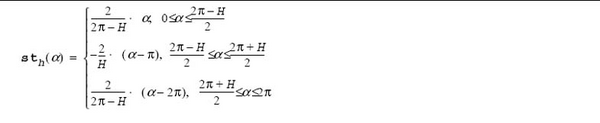
``st``h(α +k* 2π) =**st``** :sub:`h` ``(α), k = 0, ±1, ±2, …
When H = π , asymmetry h = 0, and function sth () is symmetric and a triangular analog of the sine function. Note the following equations:
``st``h(α) =**ct``** :sub:`h` ``(α + (3π +h)/2),k = 0, ±1, ±2, …
``st``h(k* π) = 0, k = 0, ±1, ±2, …
``st``h((π -h)/2 +k* 2π) = 1,k = 0, ±1, ±2, …
``st``h((3π +h)/2 +k* 2π) = -1,k = 0, ±1, ±2, …