Intel® Xeon® 6 Architecture - Performance and Efficiency Cores
Content Type: Product Information & Documentation | Article ID: 000098612 | Last Reviewed: 02/24/2026
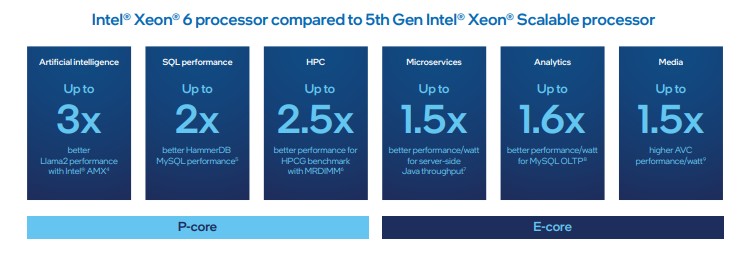
Intel® Xeon® 6 processors offer a versatile, dual-architecture strategy featuring Performance-cores (P-cores) for compute-intensive tasks and Efficient-cores (E-cores) for high-density, scalable workloads. Built on a common platform, these processors provide up to 288 cores (E-cores) for superior performance-per-watt, ideal for cloud-native applications, or high-core-count, high-frequency (P-cores) for AI and HPC. The new architecture on Intel® Xeon® 6 Processors is divided into P-core - Performance and E-core - Efficiency, with gains up to 2-3x on performance.
Intel Xeon 6 P-cores (Performance-Cores)
Intel Xeon 6 processors with P-cores are optimized for high performance per core. With more cores, double the memory bandwidth, and AI acceleration in every core, Intel Xeon 6 processors provide twice the performance for the widest range of workloads, including AI and high-performance computing (HPC).4,6 Intel Xeon 6 processors with P-cores excel at a wide range of workloads, delivering better performance than any other general-purpose CPU for compute-intensive workloads like AI inference and machine learning (ML). Intel Xeon 6 processors with P-cores are great for public cloud workloads with improved performance per vCPU for floating-point operations, transactional databases, and HPC workloads. Through their leadership in AI inferencing, Intel Xeon processors continue to be the host CPU of choice on the world’s most powerful AI accelerator platforms for data preprocessing support.
Intel Xeon 6 E-cores (Efficient-Cores)
Intel Xeon 6 processors with Efficient-cores (E-cores). Intel Xeon processors with E-cores are optimized for high core density and exceptional performance per watt, delivering distinct advantages for cloud-scale workloads that demand high task-parallel throughput. In comparison to 2nd Gen Intel Xeon Scalable processors, which make up the majority of systems within today’s data center footprint and are excellent candidates for performance per watt upgrades in competitive data centers, Intel Xeon 6 processors with E-cores can deliver more than 2.6x better results. This efficient performance is also ideal where power, space, and cooling are limited. Intel Xeon 6 processors with E-cores can:
Shared Architecture Features
Compatibility: Both types utilize the same platform and socket, allowing for infrastructure flexibility.
AI Acceleration: Both feature built-in AI acceleration (Intel® AVX and Intel® AMX/VNNI).
Security: Both include advanced security features, including Intel® TDX for confidential computing.
The efficiency of Intel Xeon 6 processors with P-cores and E-cores is highlighted by their ability to provide scalable performance per watt as server utilization increases, delivering nearly linear power-performance consumption across the load line. For performance-demanding workloads, this means power is efficiently utilized at high loads to finish jobs faster. For a scalable implementation, common to cloud or shared computing environments, this level of efficiency means that servers are only consuming the power they need when under load, reducing costs when instances are not fully utilized. The sustainability of these processors is further enhanced through system-wide power management and telemetry capabilities. These capabilities allow for increased performance per watt on a per-application basis to help with lowering overall energy consumption.
For more details, visit The Intel® Xeon® 6 Processor Family.