Coordinate (COO) format
The simplest sparse matrix format is the COO format, represented by scalar sizes (nrows, ncols, nnz), as well as three data arrays: row_ind, col_ind, and values, along with an index parameter. Each tuple, (row_ind[i], col_ind[i], values[i]), represents a non-zero value in the sparse matrix.
Unlike CSR format which has a dichotomy of unsorted versus sorted forms, COO format arrays have five broad sortedness states, two of which are unique:
Arbitrary, non-unique unsorted order,
Two partially sorted non-unique forms corresponding to
Unsorted CSR-style state with sorted row indices but column indices within rows being unsorted,
Unsorted compressed sparse column (CSC)-style state with sorted column indices but row indices within columns being unsorted,
Two unique, fully sorted forms (assuming no repeated indices contributing to the same structural non-zero location) corresponding to
Sorted CSR-style state with sorted row indices then column indices sorted within rows, and
Sorted CSC-style state with sorted column indices and row indices sorted within columns.
Knowing which of the above sortedness states the COO arrays are in allows for different optimization and algorithm choices as well as trade-offs in math APIs using COO format. However, in order to provide complete functional support for COO matrices out-of-the-box, oneMKL assumes them to be fully unsorted by default. In the context of COO matrices, the sparse::property::sortedenum (see sparse::property) corresponds to the sorted CSR-style state that users can specify on the handle, if their arrays are sorted in that form, to allow oneMKL to possibly deliver better performance compared to default unsorted case. oneMKL currently has no plans to add support for either sorted or unsorted CSC-style states. A future release of oneMKL may add a sparse::property::partially_sorted or a sparse::property::sorted_by_rows property to allow users to indicate partially sorted (i.e., unsorted CSR-style) COO arrays to the library. The current release of oneMKL has no difference in treatment between partially sorted COO arrays, which are simply treated as unsorted by default, but does have and will continue to add optimizations for sparse::property::sorted case. Therefore, whenever applicable, users are strongly encouraged to specify the sparse::property::sorted property using the sparse::set_matrix_property() API on the matrix handle if the COO arrays are known to be in sorted-CSR form.
Note that sparse::property::sorted must not be specified on a COO matrix handle created with arrays that are CSC-style sorted as that property is meant for CSR-style sorted state of COO arrays. However, because the transpose of a COO matrix is immediately available by interchanging its row and column index arrays, the transpose of a COO matrix with CSC-style-sorted arrays is automatically in CSR-style-sorted state. To possibly still take advantage of optimizations of CSC-style sorted arrays, users can create a matrix handle for the transposed matrix with the original arrays interchanged and specify the sparse::property::sorted on that handle with the sparse::set_matrix_property() API. Accordingly, subsequent users should also adjust subsequent usage of other APIs with this transposed handle appropriately using the mkl::transpose enum with the APIs. For example, non-transpose sparse::gemv() with sorted-CSC-style COO matrix is not allowed to use the sparse::property::sorted property on the matrix, but the same operation is equivalent to performing transposesparse::gemv with the transposed COO matrix handle which is easily available by interchanging the row_ind and col_ind arrays. The transposed handle then naturally has sorted-CSR-style arrays which allows users to specify the sparse::property::sorted on it. In other words, sparse::gemv(q, mkl::transpose::nontrans, cooAMatrix, ...) cannot make use of sparse::property::sorted on sorted-CSC-style arrays in cooAMatrix, but sparse::gemv(q, mkl::transpose::trans, transCooAMatrix, ...) can make use of sparse::property::sorted on transCooAMatirx which then has sorted-CSR-style arrays. Likewise, instead of sparse::gemv(q, mkl::transpose::trans, cooAMatrix, ...), users can use sparse::gemv(q, mkl::transpose::nontrans, transCooAMatrix, ...) to take advantage of the sparse::property::sorted property.
A summary of COO format sorted states is given in the table below.
COO Sortedness State |
Description |
Appropriate oneMKL sparse::property |
|---|---|---|
Unsorted |
Unsorted |
None (default) |
Unsorted CSR style/partially sorted |
Sorted by rows, but columns within each row need not be ordered |
None (support may be added in the future) |
Unsorted CSC style/partially sorted |
Sorted by columns, but rows within each column need not be ordered |
None (no plans to add support) |
Sorted CSR style |
Sorted by rows and sorted by columns within each row |
sparse::property::sorted |
Sorted CSC style |
Sorted by columns and sorted by rows within each column |
None (no plans to add support) |
COO Matrix Format Elements |
Description |
|---|---|
nrows |
Number of rows in the sparse matrix. |
ncols |
Number of columns in the sparse matrix. |
nnz |
Number of non-zeros in the sparse matrix. |
index |
Parameter that is used to specify whether the matrix has zero or one-based indexing. |
row_ind |
An integer array of row indices of non-zero elements in the values array, such that row_ind[i] is the row number (using zero- or one-based indexing) of the element of the non-zero value in values[i]. |
col_ind |
An integer array of column indices of non-zero elements in the values array, such that col_ind[i] is the column number (using zero- or one-based indexing) of the element of the non-zero value in values[i]. |
values |
An array that contains the non-zero elements of the sparse matrix, preferably but not necessarily stored in a sorted order. |
Examples of COO format
The following examples show how the sparse COO format can be used:
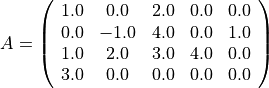
COO Case 1: Unsorted rectangular matrix with zero-based indexing
COO Case 2: Sorted rectangular matrix with one-based indexing
COO Case 3: Partially sorted rectangular matrix with one-based indexing
COO Case 1: Unsorted rectangular matrix with zero-based indexing
An example of an unsorted COO matrix in zero-based indexing and a real rectangular matrix are given below.
nrows |
4 |
|||||||||
ncols |
5 |
|||||||||
nnz |
10 |
|||||||||
index |
0 |
|||||||||
row_ind |
2 |
1 |
0 |
1 |
2 |
3 |
0 |
1 |
2 |
2 |
col_ind |
1 |
4 |
2 |
1 |
0 |
0 |
0 |
2 |
3 |
2 |
values |
2.0 |
1.0 |
2.0 |
-1.0 |
1.0 |
3.0 |
1.0 |
4.0 |
4.0 |
3.0 |
COO Case 2: Sorted rectangular matrix with one-based indexing
Consider the following dense matrix containing many zero values.
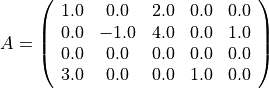
Its two fully sorted forms, viz., CSR-style sorted and CSC-style sorted representations, are given below.
CSR-style sorted form:
nrows |
4 |
||||||
ncols |
5 |
||||||
nnz |
7 |
||||||
index |
1 |
||||||
row_ind |
1 |
1 |
2 |
2 |
2 |
4 |
4 |
col_ind |
1 |
3 |
2 |
3 |
5 |
1 |
4 |
values |
1.0 |
2.0 |
-1.0 |
4.0 |
1.0 |
3.0 |
1.0 |
CSC-style sorted form:
nrows |
4 |
||||||
ncols |
5 |
||||||
nnz |
7 |
||||||
index |
1 |
||||||
row_ind |
1 |
4 |
2 |
1 |
2 |
4 |
2 |
col_ind |
1 |
1 |
2 |
3 |
3 |
4 |
5 |
values |
1.0 |
3.0 |
-1.0 |
2.0 |
4.0 |
1.0 |
1.0 |
COO Case 3: Partially sorted rectangular matrix with one-based indexing
Consider the following dense matrix containing many zero values.
Two of its non-unique partially sorted forms, viz., unsorted-CSR-style and unsorted-CSC-style representations, are given below.
CSR-style unsorted/partially sorted form:
nrows |
4 |
||||||
ncols |
5 |
||||||
nnz |
7 |
||||||
index |
1 |
||||||
row_ind |
1 |
1 |
2 |
2 |
2 |
4 |
4 |
col_ind |
1 |
3 |
5 |
2 |
3 |
4 |
1 |
values |
1.0 |
2.0 |
1.0 |
-1.0 |
4.0 |
1.0 |
3.0 |
CSC-style unsorted/partially sorted form:
nrows |
4 |
||||||
ncols |
5 |
||||||
nnz |
7 |
||||||
index |
1 |
||||||
row_ind |
4 |
1 |
2 |
1 |
2 |
4 |
2 |
col_ind |
1 |
1 |
2 |
3 |
3 |
4 |
5 |
values |
3.0 |
1.0 |
-1.0 |
2.0 |
4.0 |
1.0 |
1.0 |