Skip To Main Content
Support Knowledge Base

What Is Intel® Flat Memory Mode on Intel® Xeon® 6 and Xeon® 6+ Processors?

Content Type: Product Information & Documentation   |   Article ID: 000102525   |   Last Reviewed: 06/01/2026

Environment

Intel® Xeon® 6 and Xeon® 6+

What Is Intel® Flat Memory Mode?

Intel® Flat Memory Mode is a hardware‑managed memory tiering feature available on Intel® Xeon® 6 processors, including Xeon® 6+ processors, when used with CXL-attached memory.

Flat Memory Mode presents processor‑attached DRAM and CXL memory as a single, flat memory address space to the operating system. Memory placement between DRAM and CXL memory is automatically managed by the processor hardware, without requiring OS or application‑level memory management.


How Flat Memory Mode Differs from Default CXL Memory Behavior

Mode OS Visibility Memory Management
Default CXL Mode DRAM and CXL memory appear as separate NUMA nodes Managed by OS / application
Flat Memory Mode DRAM and CXL memory appear as a single pool Managed by processor hardware

Without Flat Memory Mode, CXL memory is exposed as NUMA nodes without attached CPU cores. With Flat Memory Mode enabled, this separation is hidden from the OS.


Supported Platforms

Intel® Flat Memory Mode is supported on:

  • Intel® Xeon® 6 Processors
  • Intel® Xeon® 6+ Processors

Support required:

  • Platform firmware (BIOS/UEFI) that enables Flat Memory Mode
  • Supported CXL Type‑3 memory devices
  • OS support as validated by the system vendor.

When to Use Flat Memory Mode

Flat Memory Mode is recommended when:

  • Applications benefit from larger memory capacity
  • Minimal changes to applications or OS configuration are desired
  • Workloads are capacity‑constrained rather than latency‑critical

Intel and partners have demonstrated Flat Memory Mode benefits in large in‑memory analytics workloads, including SQL Server OLAP scenarios.


When Flat Memory Mode May Not Be Ideal

Flat Memory Mode may not be optimal when:

  • Applications require explicit NUMA control
  • Fine‑grained memory locality management is critical
  • Developers want direct placement of data into DRAM vs CXL memory

In these cases, exposing CXL memory as separate NUMA nodes may be preferred.


Additional Notes

  • Flat Memory Mode behavior is consistent across Xeon® 6 and Xeon® 6+ processors
  • Performance characteristics depend on workload memory access patterns
  • Configuration details vary by system vendor and BIOS implementation

Relationship with CXL

While Intel Flat Memory Mode and CXL are distinct technologies, they complement each other in enhancing memory capacity, performance, and flexibility in modern computing environments. CXL can be used to connect additional memory resources, further enhancing the overall memory capacity and flexibility.

Unlike inclusive caching, there is no data replication in this mode, which means the data either exists in NM or FM. Hot data is moved to NM for faster performance.

This mode allows the use of lower-cost memory, improving TCO, and does not require any OS or application changes for managing memory tiers. Both the DDR and CXL memory are exposed to the system as a combined physical memory.
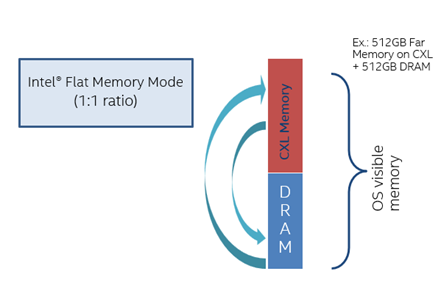
Intel Flat Memory Mode example

Key Features of CXL

  • High-Speed Interconnect: Provides low-latency, high-bandwidth communication between CPUs and other devices.
  • Memory Expansion: Supports memory pooling and sharing, allowing for more flexible and efficient use of memory resources across different components.
  • Coherent Memory Access: Ensures data consistency and coherence between the CPU and connected devices, enabling more efficient data processing and sharing.
  • Scalability: Designed to scale with future advancements in processor and memory technologies.
  • Relationship Between Intel® Flat Memory Mode and CXL: While Intel® Flat Memory Mode and CXL are distinct technologies, they are related in the context of enhancing memory capacity, performance, and flexibility in modern computing environments.
  • Memory Expansion: CXL can be used to connect additional memory resources, such as CXL-attached memory modules, to a system. This can complement the memory capacity provided by Intel® Flat Memory Mode, further enhancing the overall memory capacity and flexibility.
  • Efficient Resource Utilization: Both technologies aim to improve the efficiency of memory usage in data centers and enterprise environments. Intel® Flat Memory Mode optimizes local memory usage, while CXL enables efficient sharing and pooling of memory resources across multiple components.


In summary, Intel® Flat Memory Mode and CXL are complementary technologies that together can provide significant benefits in terms of memory capacity, performance, and flexibility, addressing the growing demands of modern computing workloads.

For more information, visit Compute Express Link* (CXL*) Supplemental Validation Guide for Birch Stream (CNDA Required).


Related Products

This article applies to 2 products.