What Is Linear Address Space Separation (LASS) on Intel® Xeon® 6 Processors?
Content Type: Product Information & Documentation | Article ID: 000098739 | Last Reviewed: 09/10/2026
Linear Address Space Separation (LASS) is a hardware-based security feature introduced in Intel® Xeon® 6 processors. It is designed to prevent unauthorized access between user-space and kernel-space memory. It acts as a preventative measure against speculative execution attacks by enforcing strict separation of the virtual address space, effectively preventing malicious application software from using page walks of arbitrary kernel addresses to infer the layout of kernel memory.
Key Features and Benefits
How LASS Works on Intel® Xeon® 6 Processors
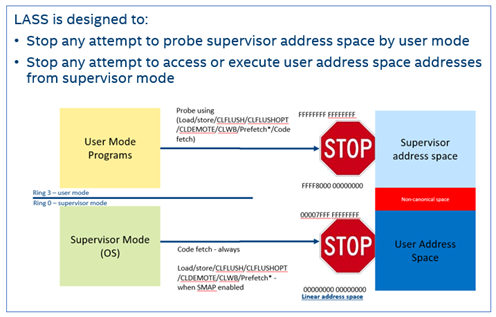
When LASS is enabled, the processor hardware monitors memory access based on the current CPU privilege level (CPL):
LASS is supported in 64-bit mode and is particularly relevant for mitigating attacks that use speculative techniques to steal data across user/kernel boundaries.
Linear address-to-physical address mapping is intended to be randomized to help prevent exploits. However, methods have been published to de-map layout randomization.
LASS prevents these methods by separating the supervisor and user address spaces, which stops memory access with malicious intent.
For more details, please visit: