As AI capabilities continue to evolve, Intel® remains dedicated to ensuring its platforms keep pace with the latest model innovations, bringing powerful AI experiences to everyone. Today, Intel is proud to announce support for Muse Glimmer, a new multimodal open-weight AI model from Meta built for agentic applications at its core. As a trusted partner of Meta, Intel has collaborated closely with the Muse Glimmer team to ensure developers have access to an optimized experience on Intel hardware. To learn more about Muse Glimmer, check out Meta’s blog here.
What is Muse Glimmer?
Muse Glimmer is a 30-billion parameter open-weight model distilled from Muse Spark, optimized for always-on local agent workflows. It’s small enough to run on a PC or single consumer GPU, such as Intel® Arc™ Pro B70, enabling use cases from local agents and function calling to local coding and synthetic data generation. Together, these capabilities make Muse Glimmer a compelling foundation for building responsive, intelligent on-device AI assistants that are fast, private, and efficient. It exhibits strong performance on key agentic use cases and benchmarks compared to leading models of this size category.
Intel enables Muse Glimmer across a broad range of hardware, from consumer laptops powered by Intel® Core™ Ultra Series 3 integrated GPUs to workstations with Intel® Arc™ Pro B70 discrete GPU configurations and Intel® Xeon® processors, ensuring developers and enterprises can deploy Muse Glimmer wherever their workflows demand.
Built for Agentic Workflows
Muse Glimmer is built from the ground up for always-on agentic workflows, not just chat. The model is capable of handling many sequential tool calls, recovery from failure, and multimodal and multi-step reasoning, making it reliable enough to run complex, multi-step agent tasks for hours or days on local hardware. Muse Glimmer is also trained to resist prompt injection from untrusted content to reduce the risk of external content hijacking the agent’s behavior.
Open and Developer-Friendly
For developers, Muse Glimmer offers maximum flexibility. Released under Apache 2.0, it is the most permissive open-source model from Meta to date. The model is optimized for popular open-source frameworks with partner support, making it straightforward to go from download to working agent in minutes using the tools developers already know.
Local-First Agentic AI on Intel: Protect Data and Optimize AI Efficiency
The rise of agentic AI represents one of the most significant shifts in how developers build and deploy intelligent applications. Unlike traditional AI interactions, agentic AI systems plan, reason, and act across multiple steps, using tools, managing memory, and adapting to new information in real time.
Intel enables developers to build and deploy capable, trustworthy, and cost-efficient AI agents on local infrastructure today. Through a growing ecosystem of software tools, including the OpenVINO™ toolkit, SuperClaw, and broad upstream framework support, Intel provides an optimized path for developing and deploying agentic AI applications with privacy, performance, and operational efficiency.
What Can You Build with Muse Glimmer?
Here are examples of what developers can build and deploy on Intel hardware today.
Full-Stack App Development with a Local AI Coding Agent | Intel® Arc™ Pro B70
This demo showcases the local agentic capabilities of Muse Glimmer in an end-to-end coding workflow running entirely on an Intel® Arc™ Pro B70 GPU with 32GB VRAM. Using Cline, an AI coding agent integrated directly into VS Code and enabled by Muse Glimmer running locally via a llama.cpp server, developers can build, iterate, and ship full-stack applications privately, at zero cloud cost.
What It Does
From a single natural-language prompt, Muse Glimmer generates a complete Customer Feedback Triage application using Cline. The generated app includes:
- A React + Vite + Tailwind CSS frontend with two views: a public customer feedback form and a private admin triage dashboard
- A Node.js + Express REST API backend with SQLite for storage
- AI-powered sentiment analysis (Positive / Negative / Neutral) routed through the same local model
- A one-command startup script that boots the full stack simultaneously
Approximately one million tokens of prompts, reasoning, and generated code, produced at zero cost: no cloud subscriptions, no API keys, and no data leaving the device.
Demo Video
Application Performance Optimizer with Hermes Agent | Dual Intel® Arc™ Pro B70
This demo highlights how Muse Glimmer enables an end-to-end performance-engineering agent running entirely on Intel hardware. Muse Glimmer is served by vLLM across dual Intel® Arc™ Pro B70 GPUs and driven by the Hermes agent on an Intel® Core™ Ultra Series client, with source code and benchmark data never leaving the network.
What It Does
When a developer reports that an application degrades under load, the Hermes agent autonomously takes over, running a full performance engineering loop that would typically cost an engineer a full day of work:
- Source-driven test design that reads the application, discovers its routes and authentication requirements unaided, and writes a staged k6 workload with correctness assertions
- A recorded baseline and threshold set before a single line is optimized
- Live load testing against the running server, reasoning over real k6 load rather than estimates
- An optimized application revision with caching, deterministic latency, and keep-alive tuning, with all functional checks passing at a 0% error rate
A full run completes in approximately 20 minutes, after dozens of tool calls, two completed k6 load tests, delivering five artifacts: a benchmark script, baseline report, optimized application, comparison report, and SVG flowchart, all processed locally with no external dependencies.
Demo Video
Autonomous Post-Sale Operations with a Local AI Agent | Intel® Core™ Ultra Series 3
Muse Glimmer takes on the role of an autonomous post-sale operations agent in this demo, running entirely on an Intel® Core™ Ultra Series 3. Muse Glimmer is served through llama.cpp via a FastAPI orchestrator, enabling a sales team to close deals with signed contracts, pricing, and customer data staying on the device with zero cloud cost.
What It Does
When a sales rep marks a deal closed, the agent autonomously runs the entire post-sale handoff process that would typically take a team days of email and spreadsheet chasing:
- Multi-hop contract discovery across six documents in a genuine reason, act, and observe loop, where the model's comprehension of each document determines what to read next
- Grounded extraction that reconciles line items against the real product catalogue, recording any missing documents as gaps rather than guessing
- Concurrent fulfillment and activation, generating purchase orders, onboarding tickets, and welcome emails in parallel behind a validation barrier
- Policy-bound escalation that routes for human approval when a discount exceeds the authority threshold found in the contract chain
- A complete audit trail of which clause led where, which terms took precedence, and which were superseded
A full run executes roughly 20,000 tokens of prompts, reasoning, and structured output across ten model calls and a six-document contract chain, all processed locally, with sensitive contract data and business logic staying entirely on device.
Demo Video
Email Productivity Agent with SuperClaw | Dual Intel® Arc™ Pro B70
Local Agentic AI with Intel SuperClaw
The agentic capabilities of Muse Glimmer complement Intel's broader agentic architecture, as demonstrated through the SuperClaw platform. Designed to showcase a local-first, hardware-accelerated agent runtime, the platform routes high-frequency and sensitive workloads to local Intel hardware while reserving cloud resources for more complex reasoning tasks. Running Muse Glimmer models in this environment enables agentic reasoning, tool calling, adaptive local-cloud routing, and multi-session orchestration, delivering a privacy-conscious and cost-efficient solution.
What It Does
In this demo, Muse Glimmer enables an autonomous email intelligence agent, running on dual Intel® Arc™ Pro B70 GPUs through the SuperClaw platform. Given access to several months of email communications, the agent identifies, extracts, and synthesizes the most relevant information entirely on-device, with sensitive business data never leaving the network.
When a team member needs a consolidated view of the project, the agent autonomously works through months of email history to deliver a comprehensive project summary, replacing hours of manual inbox searches:
- Project Overview: A high-level description of Project NorthStar, including the technologies being used, key objectives, and budget
- Timeline: The original project schedule, subsequent changes, key milestones, and the latest expected dates
- Key Risks and Issues: Identified budget concerns, security findings, technical challenges, and other risks that may affect project execution
- Client and Business Impact: Relevant sales pipeline information, client feedback, revenue projections, and other business implications
- Current Status: A concise assessment of where the project stands based on the most recent communications and updates
All processed locally through Muse Glimmer and SuperClaw, with sensitive business communications and project data staying entirely within the organization.
Demo Video
OpenVINO™ Toolkit Optimizations: Maximizing Intel Hardware Performance
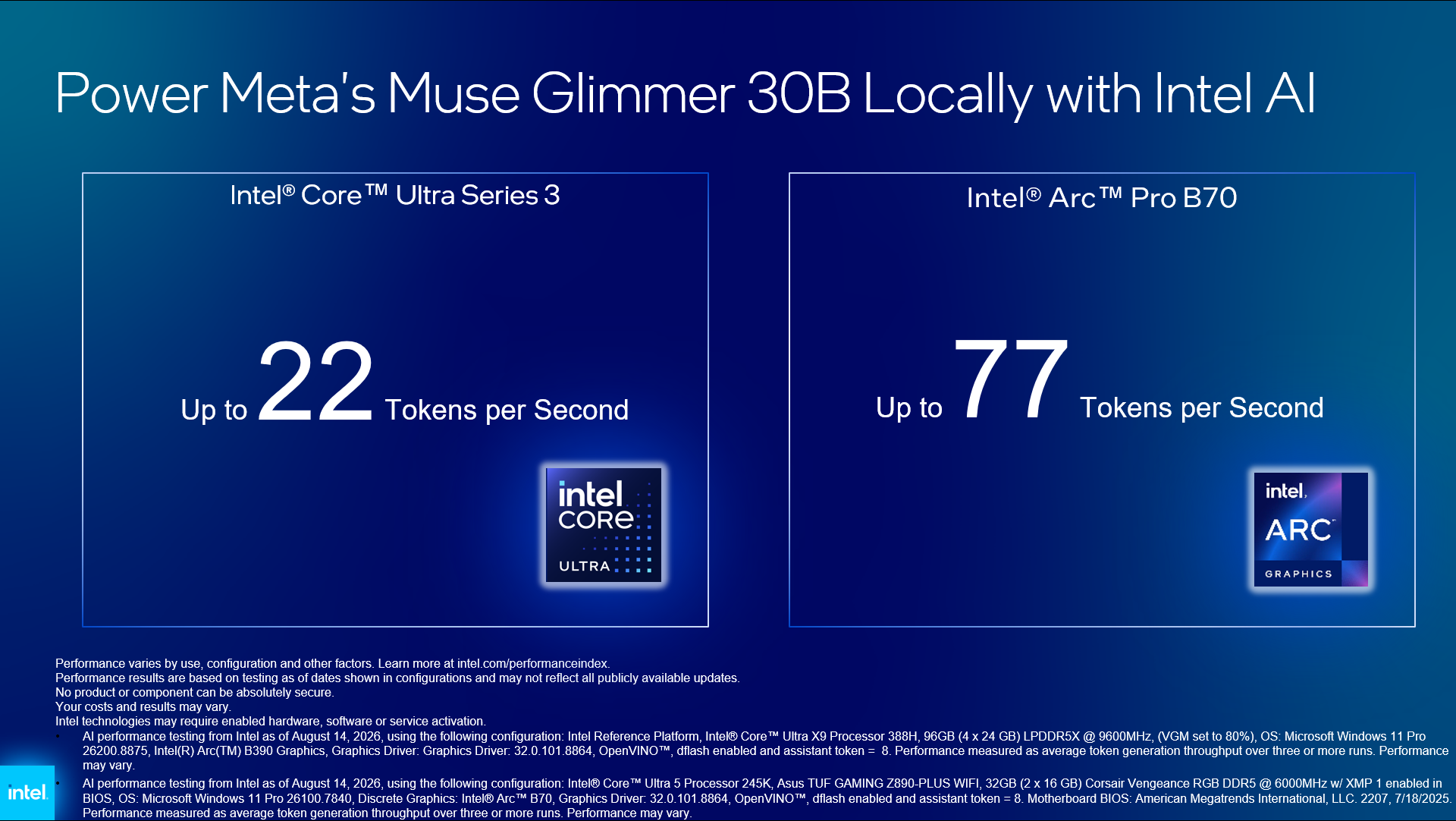
Through OpenVINO™, Intel's open-source toolkit for high-performance AI inference, both CPU and GPU resources are leveraged to maximize throughput and minimize latency on Intel hardware with Muse Glimmer. OpenVINO™ further enhances the performance of Muse Glimmer through advanced speculative decoding techniques, including DFlash, accelerating token generation to deliver the fast, low-latency responses that agentic workflows demand. Day 0 support for Muse Glimmer on Intel platforms extends across key OpenVINO™ ecosystem tools, including OpenVINO™ GenAI for streamlined generative AI pipeline development, OpenVINO™ Model Server (OVMS) for scalable and efficient model serving through OpenAI-compatible endpoints, efficient tool calling, and agentic AI workflows, and Optimum Intel for seamless integration with Hugging Face workflows. Together, these tools and optimizations give developers a flexible and powerful path to deploying Muse Glimmer locally on Intel hardware, with the performance and reliability that production agentic applications demand.
Performance Benchmarks with OpenVINO
Day 0 Support with Upstream AI Frameworks
Intel is deeply committed to empowering the AI ecosystem through an open, frictionless developer experience. Intel solutions are natively supported across key community frameworks, including llama.cpp, vLLM, PyTorch, ExecuTorch, and Hugging Face Transformers, covering the full spectrum of AI workloads from AI PC/edge and on-device execution to cloud data centers, across Intel® Xeon® processors, recently launched Intel® Arc™ Pro B70, and Intel® Core™ Ultra processors.
At the heart of this ecosystem strategy is Intel’s “Upstream First” commitment. Intel actively contributes performance optimizations, hardware accelerations, and architecture features directly back into the upstream mainlines of these open-source projects, ensuring that developers can innovate with confidence, knowing their applications will run seamlessly and efficiently on Intel platforms from Day 0.
Get Started with Muse Glimmer on Intel Hardware Today
Ready to build your own agentic AI applications with Muse Glimmer from Meta? Download the model from Hugging Face and dive in with the resources below.
Try the Demos
Get hands-on with Muse Glimmer through our ready-to-run demos, each showcasing a different agentic use case on Intel hardware:
Full-Stack App Development with a Local AI Coding Agent | Intel® Arc™ Pro B70
Application Performance Optimizer with Hermes Agent | Dual Intel® Arc™ Pro B70
Autonomous Post-Sale Operations with a Local AI Agent | Intel® Core™ Ultra Series 3
Email Productivity Agent with SuperClaw | Dual Intel® Arc™ Pro B70
Get Started with vLLM, Hugging Face Transformers, and PyTorch
Check out the cookbook Day 0 Muse Glimmer Support on Intel Platforms with vLLM and Hugging Face to run Muse Glimmer on Intel® Xeon® servers and Intel® Arc™ Pro B60/B70 GPUs using vLLM and Hugging Face Transformers.
Get Started with OpenVINO
Pre-optimized INT4 model and deployment steps on Hugging Face
Getting started notebooks:
Blog: Running Meta’s Muse Glimmer 30B Locally with OpenVINO™ GenAI
Summary
For developers looking to build the next generation of local, private, and capable AI agents, Muse Glimmer on Intel hardware combines Day 0 framework support, optimized software, and Intel hardware into a unified system for agentic AI development and deployment. With a permissive Apache 2.0 license, strong multimodal and agentic capabilities out of the box, and support through upstream AI frameworks (llama.cpp, vLLM, Hugging Face Transformers, and PyTorch) and OpenVINO™ toolkit, developers can go from download to working agent quickly and confidently. Whether targeting a thin-and-light consumer laptop or a professional workstation, Intel's broad hardware portfolio provides the performance, flexibility, and tooling to bring agents enabled by Muse Glimmer to life, all while keeping data private and on-device.
Product Information
Learn more about Intel® Core™ Ultra Series 3
Learn more about Intel® Arc™ Pro B70
Notes & Disclaimers
Performance varies by use, configuration and other factors. Learn more at intel.com/performanceindex.
Performance results are based on testing as of dates shown in configurations and may not reflect all publicly available updates.
No product or component can be absolutely secure.
Your costs and results may vary.
Intel technologies may require enabled hardware, software or service activation.
Benchmark configuration details:
- AI performance testing from Intel as of August 14, 2026, using the following configuration: Intel Reference Platform, Intel® Core™ Ultra X9 Processor 388H, 96GB (4 x 24 GB) LPDDR5X @ 9600MHz, (VGM set to 80%), OS: Microsoft Windows 11 Pro 26200.8875, Intel(R) Arc(TM) B390 Graphics, Graphics Driver: Graphics Driver: 32.0.101.8864, OpenVINO™, dflash enabled and assistant token = 8. Performance measured as average token generation throughput over three or more runs. Performance may vary.
- AI performance testing from Intel as of August 14, 2026, using the following configuration: Intel® Core™ Ultra 5 Processor 245K, Asus TUF GAMING Z890-PLUS WIFI, 32GB (2 x 16 GB) Corsair Vengeance RGB DDR5 @ 6000MHz w/ XMP 1 enabled in BIOS, OS: Microsoft Windows 11 Pro 26100.7840, Discrete Graphics: Intel® Arc™ B70, Graphics Driver: 32.0.101.8864, OpenVINO™, dflash enabled and assistant token = 8. Motherboard BIOS: American Megatrends International, LLC. 2207, 7/18/2025. Performance measured as average token generation throughput over three or more runs. Performance may vary.