|
 |
 |
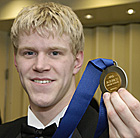
Herbert Mason Hedberg Is Nation's Top High School ScientistIntel Awards $100,000 First-Place Scholarship, $530,000 in Total PrizesWashington, D.C., March 16, 2004 - Intel Corporation today awarded Herbert Mason Hedberg of North Attleboro, Mass. a $100,000 scholarship and top honors in the Intel Science Talent Search (Intel STS), America's oldest and most prestigious high school science competition that is often called the "junior Nobel Prize." Hedberg, 17, of North Attleboro High School, developed a faster, more efficient method to diagnose cancer by screening for telomerase inhibitors and ranking their potency as potential tumor suppressors. Hedberg, an aspiring physician-scientist, is a competitive swimmer and founder of "Exciting Elementary Science," a program to encourage scientific curiosity in young students. The second-place prize, a $75,000 scholarship, went to Boris Alexeev, 17, of Cedar Shoals High School, Athens, Ga. His research deals with the theory of automata, a simple model of computation that is the mathematical basis for pattern matching and can be used in fields such as genetics and speech recognition. In addition to his love of research, Alexeev enjoys the outdoors and is an avid rock climber. Ryna Karnik, 17, of Oregon Episcopal School in Portland, Ore. won the third-place $50,000 scholarship for her patent-pending design method for constructing microchips which may save developers time and money when creating and testing prototype semiconductor chips. Karnik enjoys tutoring elementary school students and is a Junior Olympics competitor in saber fencing. "The Intel STS finalists serve as a reminder that many U.S. schools, teachers and students are excelling in science and math," said Craig Barrett, Intel chief executive officer. "These exceptional young scientists are already producing the kind of innovative thinking and solid results that this country absolutely must have to keep America the center of innovation." Rounding out the top 10 winners:
The remaining 30 finalists will each receive a $5,000 scholarship and all students will receive an Intel® Centrino™ Mobile Technology-based notebook computer. Washington, D.C., Highlights Judging "The Intel STS is an excellent way to discover America's future leaders in science and technology," Dr. Yeager said. "The judging committee selected these 10 students based on their overall knowledge of the sciences, ability to apply science to problem solving, ability to think creatively and uniquely, and passion for scientific research." Background Founded in 1921, Science Service is a nonprofit organization whose mission is to advance the understanding and appreciation of science among people of all ages through publications and educational programs. Over the years, the Intel STS competition has recognized more than 2,500 finalists with more than $5 million in scholarships. For more information on Science Service, visit www.sciserv.org. Intel's sponsorship of the STS is part of the Intel® Innovation in Education initiative, a collaboration with educators around the world to improve the quality of science, mathematics, engineering and technology education to help students develop the higher-level thinking skills they need to participate and succeed in a knowledge-based economy. For more information, visit www.intel.com/education. Intel and Intel Centrino are trademarks or registered trademark of Intel Corporation or its subsidiaries in the United States and other countries. * Other names and brands may be claimed as the property of others. |
|
Click image to download high resolution version
|